

Type
Course
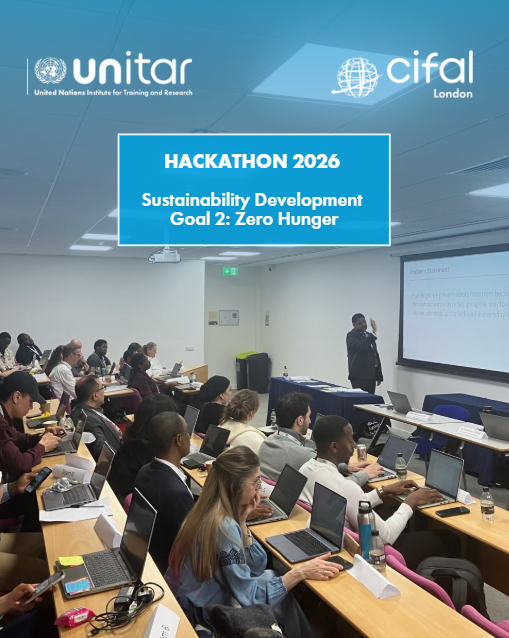
CIFAL London - GBS Hackathon 2026 – SDG 2 Zero Hunger (Food Waste Reduction Challenge)
Location
GBS Greenford Campus 891 Greenford Rd Greenford UB6 0HE , United Kingdom of Great Britain and Northern Ireland
Date
Duration
1 Hours
Thematic Area
Decentralize Cooperation Programme
Registration
Open-registration event
Mode of Delivery
Face-to-Face
Language(s)
English
Pillar
People
Partnership
CIFAL London (UNITAR Network) & Global Banking School (GBS)
Event Objectives
The event aims to engage participants in addressing household food waste as a critical sustainability challenge by developing innovative, practical, and scalable solutions aligned with Sustainable Development Goal 2: Zero Hunger. It seeks to strengthen systems thinking, collaborative problem-solving, and the ability to translate sustainability concepts into actionable interventions.
Background
Household food waste in the United Kingdom represents a significant sustainability challenge, with a substantial proportion of edible food being discarded at the consumer level. This results in considerable economic loss and environmental impact. The GBS Hackathon 2026, aligned with Sustainable Development Goal 2: Zero Hunger, was designed to address this issue by engaging students and staff in developing innovative, practical, and scalable solutions. The initiative focuses on improving food storage practices, influencing behavioural change, enhancing purchasing decisions, and promoting community-based redistribution models. By fostering creativity and systems thinking, the event aims to contribute to reducing food waste and supporting more sustainable food systems. The activity primarily contributes to SDG 2 (Zero Hunger), with strong alignment to SDG 12 (Responsible Consumption and Production), and additional contributions to SDG 11 (Sustainable Cities and Communities), SDG 13 (Climate Action), and SDG 1 (No Poverty).
Learning Objectives
- Critically analyse the systemic and behavioural drivers of household food waste: Participants will demonstrate an understanding of the scale, economic impact, and underlying behavioural causes of food waste in the United Kingdom, and critically evaluate how everyday practices (e.g., purchasing, storage, consumption habits) contribute to inefficiencies within food systems. Participants will also consider the broader impact on agricultural waste, resource management, and disaster risk reduction.
- Apply systems thinking to design practical and scalable solutions: Participants will be able to design innovative, evidence-informed solutions that address food waste at the household or community level, incorporating considerations of feasibility, scalability, inclusivity, and real-world implementation. Solutions will also align with climate action and sustainable cities objectives.
- Collaborate effectively to co-create interdisciplinary and innovative solutions: Participants will demonstrate the ability to work collaboratively in diverse teams, integrating different perspectives to co-design solutions that encourage creative thinking, out-of-the-box approaches, and balance creativity, practicality, and social impact.
- Translate sustainability concepts into actionable interventions aligned with Sustainable Development Goal 2: Zero Hunger: Participants will be able to connect global sustainability goals to local challenges by designing interventions that contribute meaningfully to reducing food waste and advancing sustainable food systems. They will also consider social development, health, and nutrition outcomes, ensuring interventions benefit both communities and individuals.
- Present and justify solutions with clarity and impact: Participants will collaborate effectively in diverse teams, present and articulate their ideas effectively, providing clear justification for their proposed solutions, including expected impact, behavioural change mechanisms, and potential for adoption. Presentations should highlight both the innovative and practical aspects of their solutions, demonstrating alignment with sustainability, social, and climate goals.
Content and Structure
The event is structured as a one-day, challenge-based learning intervention comprising three sequential phases: context setting and problem exploration, collaborative solution development, and presentation and evaluation. During the initial phase, participants are introduced to the challenge of household food waste through a facilitated briefing, including key data, contextual insights, and policy relevance related to Sustainable Development Goal 2: Zero Hunger and sustainable urban systems. This phase aims to establish a shared understanding of the systemic, behavioural, and environmental dimensions of the issue. In the second phase, participants work in interdisciplinary teams to co-design innovative, practical, and scalable solutions. This process is supported by guided facilitation and the integration of behavioural and sustainability principles. Teams are encouraged to develop solutions that are feasible, inclusive, and aligned with real-world implementation contexts. The final phase consists of team presentations and peer/expert evaluation. Participants present their proposed solutions, outlining their rationale, expected impact, and implementation approach. Solutions are assessed based on criteria such as innovation, feasibility, scalability, and potential for real-world impact. The event concludes with feedback, reflection, and evaluation activities, including participant surveys and knowledge assessment, to support learning outcomes and continuous improvement.
Methodology
The event adopts a challenge-based, experiential learning approach aligned with competency-based training principles. Participants engage with a real-world sustainability challenge linked to Sustainable Development Goal 2: Zero Hunger, progressing through a structured learning cycle of contextual understanding, practical application, reflection, and evaluation. Learning is facilitated through interdisciplinary teamwork, guided instruction, and iterative problem-solving. Participants are supported in applying systems thinking and behavioural insights to develop realistic and context-sensitive solutions while integrating diverse perspectives and approaches.
The methodology emphasises:
Active learning through hands-on participation and solution development;
Collaborative learning through team-based co-creation and peer exchange;
Problem-based learning focused on addressing a defined sustainability challenge;
Reflective learning supported by feedback and evaluation mechanisms.
Assessment is embedded throughout the learning process and aligned with the defined learning objectives. It includes team-based presentations evaluated against pre-defined criteria (innovation, feasibility, scalability, and sustainability impact), as well as individual feedback tools such as Level 1 evaluation surveys and knowledge-based Q&A.
This approach ensures coherence between learning objectives, delivery methods, and assessment, in line with United Nations Institute for Training and Research / CIFAL Global Network quality assurance standards, and supports the development of practical competencies relevant to sustainable development, employability, and civic engagement.
Targeted Audience
Higher education students and academic/professional staff
Additional Information
The hackathon contributes to raising awareness of responsible consumption practices and aligns with global sustainability priorities, particularly SDG 2 (Zero Hunger), while supporting the development of transversal competencies such as innovation, systems thinking, and sustainability-oriented problem solving in line with CIFAL and UNITAR capacity-building objectives.
Data Protection and Privacy
The personal data of participants applying for, registering for or participating in UNITAR's training courses and other events is governed by the Data Protection and Privacy Policy. By applying for, registering for or participating in this event, the participant acknowledges that he or she is, (or they are) aware of the policy and agree to its terms.