
Type
Webinar
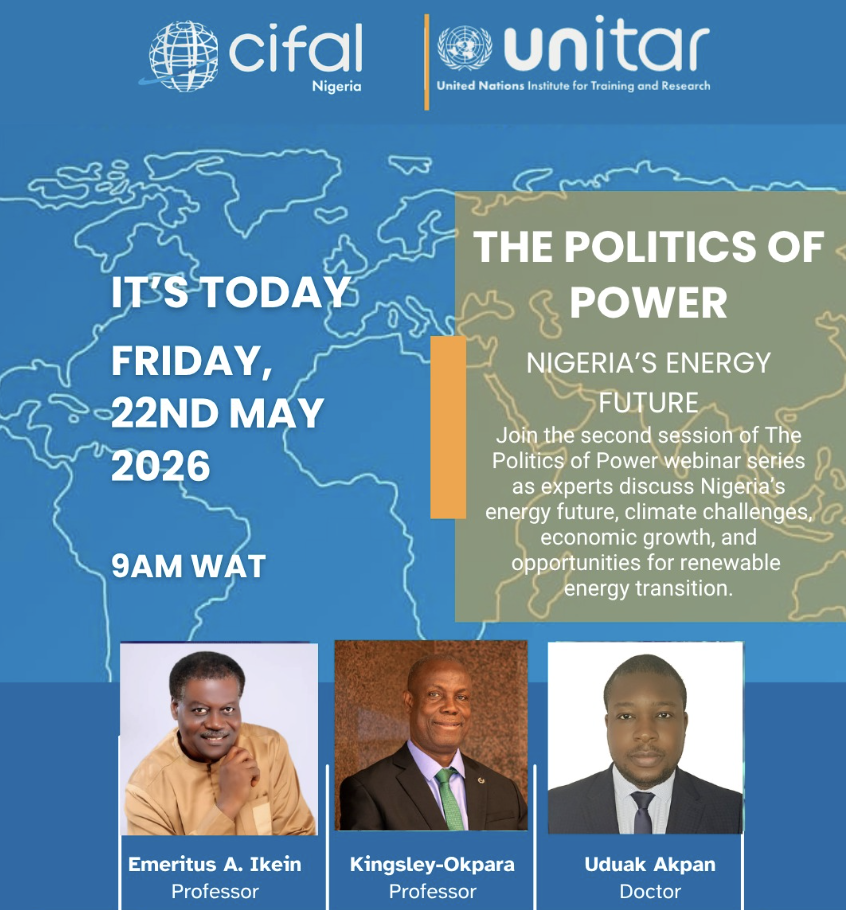
CIFAL Nigeria - The Politics of Power: Energy Security, Resource Wealth and the Global Energy Transition
Location
Web-based
Date
-
Duration
5 Hours
Thematic Area
Decentralize Cooperation Programme
Registration
Open-registration event
Mode of Delivery
E-learning
Language(s)
English
Pillar
People
Partnership
CIFAL Nigeria, CIFAL Surrey, CIFAL Newcastle
Event Objectives
- Examine the political economy of energy security and resource wealth in Nigeria;
- Assess the implications of the global energy transition for fossil fuel–dependent economies;
- Analyze governance, institutional, and environmental challenges in oil-producing regions;
- Explore pathways for converting fossil fuel revenues into sustainable national development;
- Strengthen African representation in global energy transition debates.
Background
As global climate policies intensify and nations accelerate the transition from fossil fuels to renewable energy, resource-rich developing countries face complex policy dilemmas. Nigeria, Africa’s largest oil and gas producer, remains heavily dependent on hydrocarbons while grappling with poverty, infrastructure deficits, environmental degradation, and governance challenges.
The second edition of the global webinar series “The Politics of Power: Energy Security, Resource Wealth and the Global Energy Transition” examined Nigeria’s strategic position in this evolving global energy landscape.
The session brought together international scholars and policy experts to debate whether Nigeria should prioritize converting oil and gas wealth into sustainable national prosperity before aggressively pursuing renewable energy transition.
Discussions highlighted historical exploitation of the Niger Delta, environmental devastation, weak institutions, inequality, and the urgent need for inclusive economic transformation.
Learning Objectives
By the end of the webinar, participants were able to:
- Understand the structural link between resource wealth and underdevelopment (“resource curse” dynamics);
- Identify governance gaps and environmental impacts in oil-producing regions such as the Niger Delta;
- Evaluate policy trade-offs between fossil fuel dependency and renewable energy transition;
- Recognize the need for industrial and institutional readiness before large-scale renewable transition;
- Engage in evidence-based dialogue on climate justice and energy equity.
Content and Structure
- Historical Context of Resource Exploitation
- Slave trade to crude oil extraction
- Niger Delta as a long-standing resource base
- Resource Wealth and Underdevelopment
- Environmental degradation and oil spills
- Weak infrastructure and unreliable domestic energy supply
- Poverty and social unrest in oil-producing communities
- Environmental and Public Health Impacts
- Toxic contamination and ecosystem destruction
- Gas flaring and oil spill statistics
- Health risks and reduced life expectancy
- Governance and Institutional Challenges
- Petroleum Industry Act and host community provisions
- Derivation formula debates
- Elite capture and rent-seeking
- Energy Transition and Industrial Capacity
- Solar potential vs. industrial readiness
- Import dependency for renewable technology
- Strategic sequencing of economic transformation
- Global Energy Politics & African Voice
- Climate justice considerations
- Ensuring African participation in global policy discourse
Methodology
- Expert presentations
- Policy dialogue and debate
- Comparative international analysis
- Evidence-based discussion
- Interactive Q&A session
The webinar combined academic research, policy critique, and strategic development insights.
Targeted Audience
- Policymakers
- Academics and researchers
- Energy sector professionals
- Civil society organizations
- Development practitioners
- Students and scholars of environmental governance
Data Protection and Privacy
The personal data of participants applying for, registering for or participating in UNITAR's training courses and other events is governed by the Data Protection and Privacy Policy. By applying for, registering for or participating in this event, the participant acknowledges that he or she is, (or they are) aware of the policy and agree to its terms.