

种类
Webinar
UNITAR RISE-LAB 2026 Sudan Phase One: (Webinar 2) Market Access, Food Prices, and Local Value Chains
位置
Web-based
日期
期限
2 Hours
项目领域
Climate, Environment and Natural Resources,
Water Resources Management,
Sustainable Agriculture and Food Systems,
Green Economy and Sustainable Production,
Entrepreneurship
登记
Application-based event
交货方式
E-learning
语言
Arabic,
English
支柱
Prosperity
活动目标
The webinar aimed to strengthen participants’ understanding of how market access, food prices and local value chains are connected to food security and livelihoods. It sought to explain how conflict-related disruptions to transportation, storage, trade and market systems affect producers, traders and consumers; introduce participants to the structure and functioning of selected agricultural value chains; and encourage them to identify entrepreneurial opportunities that respond to gaps and challenges within those value chains.
The session also aimed to help participants move beyond identifying general food-security problems by examining where problems occur within production, aggregation, transportation, processing, marketing and distribution systems, and where practical business solutions may create value.
背景信息
The webinar “Market Access, Food Prices, and Local Value Chains” was delivered as part of Phase One of UNITAR RISE-LAB 2026 Sudan. The session was led by Mr Takunda Ruvaro, Resilience and Development Portfolio Team Leader at CARE Sudan. It examined how conflict affects markets, transportation, storage, food prices and local value chains in Sudan, and how these disruptions influence food security, agricultural livelihoods and economic activity. The webinar also helped participants connect current market challenges with practical agribusiness and livelihood opportunities that respond to real conditions in Sudan.
学习目标
By the end of the webinar, participants were expected to explain the four dimensions of food security: availability, access, utilization and stability; understand disruptions to transportation and storage systems in Sudan; recognize the challenges faced by traders and other market actors; understand how rising commodity prices affect food security; and develop agribusiness and livelihood ideas that respond to actual market conditions.
内容和框架
The session began by introducing the wider context of markets, prices and local value chains in Sudan, including the effects of insecurity, delayed imports, rising transportation costs, shortages of essential goods, fuel and fertilizer price increases, and currency depreciation. It then revisited the four dimensions of food security and demonstrated how market prices, purchasing power, distribution, transportation and price stability influence whether households can consistently access sufficient and nutritious food.
The webinar examined market access constraints caused by conflict, infrastructure damage, inflation, weak consumer demand and import restrictions. Particular attention was given to logistical and supply-chain barriers, including disruption of traditional trade routes, rising fuel and transaction costs, price volatility and increasingly fragmented markets.
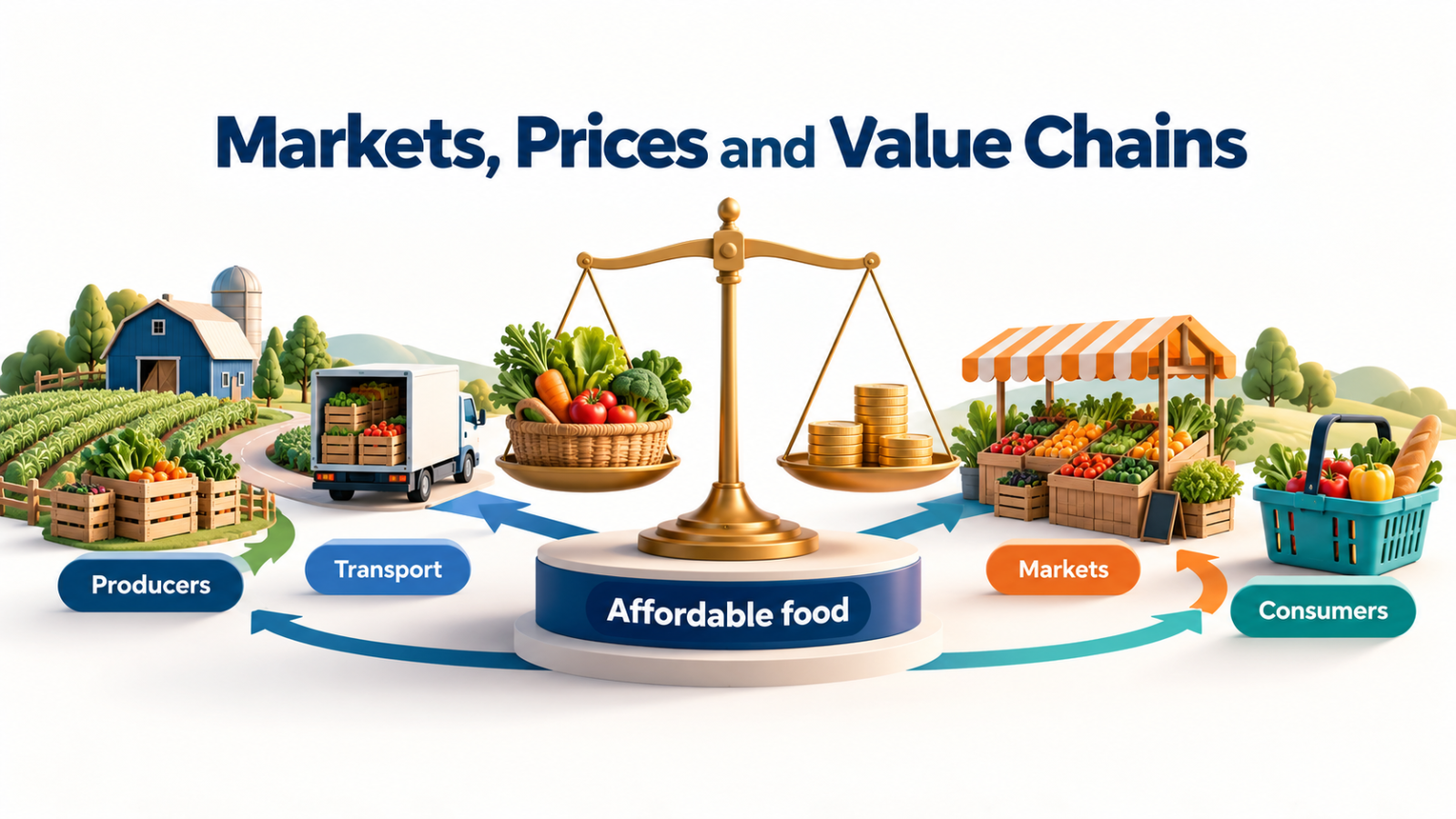
Participants were introduced to the concept of a local value chain as the network of people, businesses and activities involved in producing and delivering products and services within a particular area. Practical value-chain examples were provided for groundnuts, sorghum and vegetables, illustrating the roles of producers, input suppliers, village merchants, aggregators, wholesalers, retailers, processors, transport providers and consumers. The webinar also discussed other important Sudanese value chains, including livestock, sesame, gum arabic and hibiscus, together with their opportunities and risks.
The second part of the session focused on practical market disruptions, including high transportation costs, reduced agricultural market access, rising prices and their impact on household purchasing power, nutrition and agricultural production. Challenges faced by smallholder farmers, pastoralists, traders, consumers and humanitarian actors were also examined.
The webinar then presented examples of existing responses, such as digital marketplaces and mobile-money systems, producer associations, community-based seed systems, women- and youth-led enterprises and collective export arrangements. CARE Sudan’s interventions in agriculture, livelihood diversification, business grants, value addition, food processing, irrigation, finance and cooperatives were also introduced.
The final section translated these market challenges into possible business opportunities. Examples included community food baskets, solar-powered cold storage for vegetables and milk, urban farming and intensive horticulture, food-processing cooperatives, mobile grain milling, community kitchens, solar food drying, digital marketplaces linking farmers and buyers, livestock-feed production, and poultry and egg production.
方法
The webinar used an applied and evidence-based learning approach combining presentations, market information, value-chain diagrams, field examples, practical business cases and experiences from CARE Sudan’s work. Participants were encouraged to compare the challenges presented with conditions in their own communities and consider where gaps may exist within local agricultural and food systems.
The learning process moved progressively from understanding markets and value chains to identifying disruptions, examining existing responses and considering possible entrepreneurial solutions. Practical business examples were used to demonstrate how participants could transform a clearly identified market problem into a potential product, service or livelihood opportunity.
目标受众
The webinar was designed for participants enrolled in UNITAR RISE-LAB 2026 Sudan and South Sudan Phase One, including aspiring and existing entrepreneurs, agricultural producers, women affected by conflict and displacement, and individuals seeking to strengthen livelihoods and community food security.
The session was particularly relevant for participants exploring business ideas related to agriculture, food production, processing, transportation, storage, distribution, market access and other activities within local value chains.
更多信息
The webinar was delivered in collaboration with CARE Sudan and presented by Mr Takunda Ruvaro, Resilience and Development Portfolio Team Leader. It built on CARE Sudan’s field experience and practical understanding of food-security systems, markets and agricultural value chains.
The session contributes to the wider objectives of UNITAR RISE-LAB 2026 by helping participants understand how market and livelihood challenges can be transformed into locally relevant entrepreneurial opportunities. The programme is delivered by UNITAR’s Division for Prosperity through the RISE-LAB team with support from the Government and People of Japan.
Data Protection and Privacy
The personal data of participants applying for, registering for or participating in UNITAR's training courses and other events is governed by the Data Protection and Privacy Policy. By applying for, registering for or participating in this event, the participant acknowledges that he or she is, (or they are) aware of the policy and agree to its terms.