

Type
Course
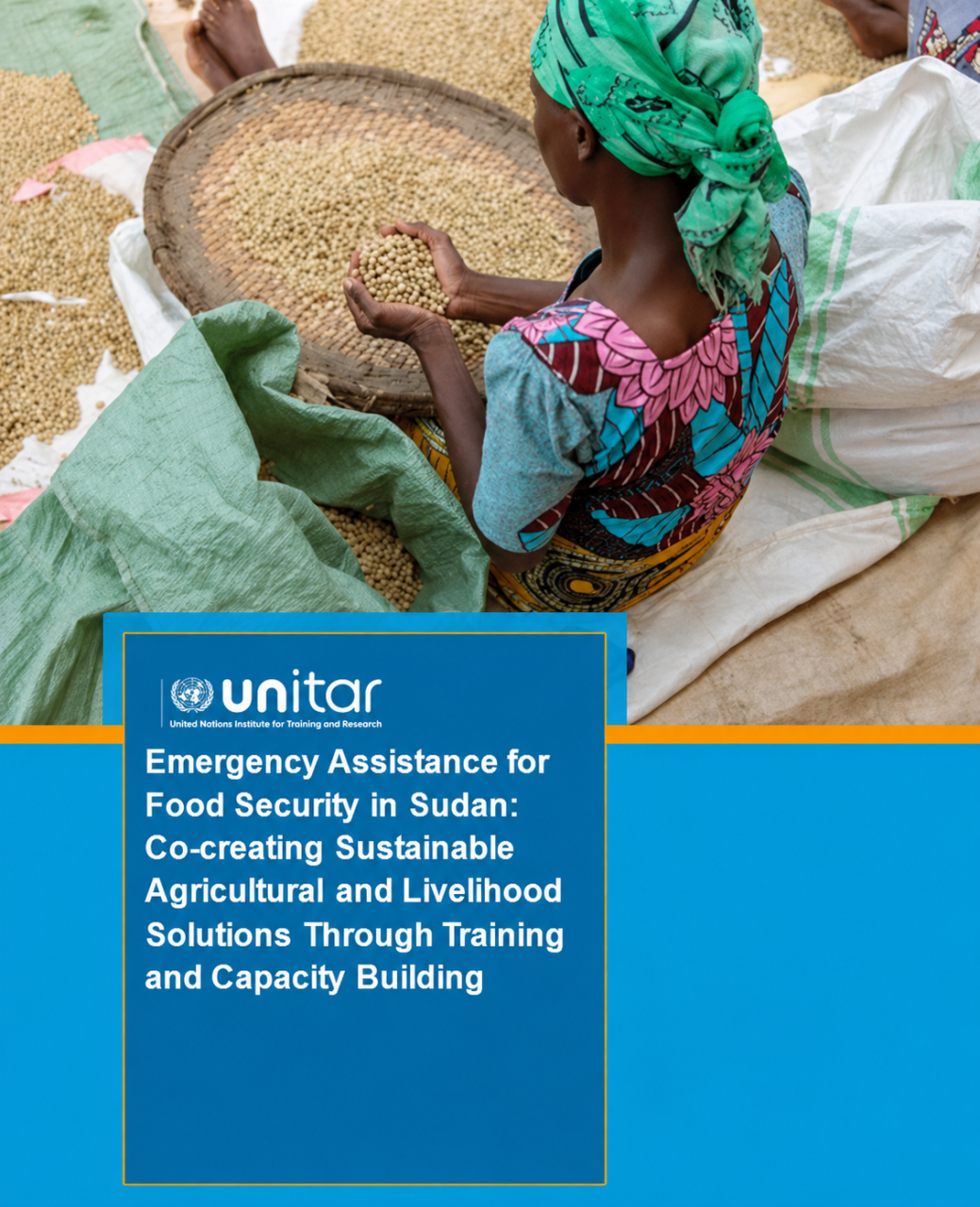
UNITAR RISE-LAB 2026 Sudan Programme Phase One: Co-creating Sustainable Agricultural and Livelihood Solutions Through Capacity Building
Location
Web-based
Date
-
Duration
8 Weeks
Thematic Area
Climate, Environment and Natural Resources,
Sustainable Agriculture and Food Systems,
Green Economy and Sustainable Production,
Entrepreneurship,
Gender equality and social inclusion,
Youth engagement
Registration
Application-based event
Mode of Delivery
E-learning
Language(s)
Arabic,
English
Pillar
Prosperity
Event Objectives
The initiative aims to strengthen food security, sustainable livelihoods and local economic recovery in Sudan by equipping conflict-affected women and IDPs with the knowledge, tools, networks and confidence to design, launch or expand inclusive, market-oriented and climate-smart agribusiness initiatives.
Background
The programme on Emergency Assistance for Food Security in Sudan: Co-creating Sustainable Agricultural and Livelihood Solutions Through Training and Capacity-Building aims to support conflict-affected women and internally displaced persons (IDPs) in Sudan through practical training in climate-smart agribusiness, emergency livelihood recovery, agricultural entrepreneurship, digital innovation and leadership. The 12-month programme will be implemented through an inception phase and three progressive learning phases, moving from foundational skills and business blueprint development to advanced applied training, mentorship and acceleration. By strengthening skills, market access and locally led enterprise development, the programme seeks to help participants restore food production, generate income, strengthen community resilience and reduce long-term dependence on uncertain humanitarian assistance.
Learning Objectives
Participants will develop practical skills in entrepreneurship, business planning, climate-smart agriculture, digital innovation, artificial intelligence applications in agriculture, leadership, financial and human resource management, market analysis and partnership development. They will also learn to assess food-security and livelihood challenges, design resilient and gender-responsive agribusiness models, communicate ideas effectively and develop launch-ready business plans suited to fragile and crisis-affected contexts.
Content and Structure
The 12-month programme runs from April 2026 to March 2027. Following stakeholder mapping, partnership engagement and a needs assessment, Phase I will provide around 25 participants with three months of virtual training and support them to prepare initial business blueprints. Around 10 top performers will advance to Phase II for two months of applied training focused on scaling, sustainability, social impact and monitoring and evaluation. Around five finalists will then enter Phase III for 1.5 months of tailored mentorship and acceleration, refining their blueprints into fully developed, launch-ready business plans. Certification, evaluation, visibility activities and final reporting will conclude the programme.
Methodology
The programme combines self-paced online learning, interactive webinars, practical assignments, peer exchange, coaching, mentoring and applied project development. It uses learner-centred and low-bandwidth approaches to ensure accessibility in a fragile operating environment. Training will be delivered in Arabic and English and will draw on Sudanese partners, regional specialists, UNITAR alumni and Japanese institutions and experts to provide technical knowledge, market insights, technology transfer and networking opportunities.
Targeted Audience
The programme targets around 25 conflict-affected women professionals, internally displaced small-scale farmers, agricultural producers and micro-entrepreneurs across Sudan. Participants should be motivated to develop climate-smart and market-oriented agricultural solutions, strengthen leadership and agribusiness skills, and launch or scale locally led initiatives that restore production and reduce reliance on emergency food aid.
Additional Information
Delivered by UNITAR’s Division for Prosperity, the programme is funded by the Government and People of Japan and aligns with Japan’s human-security priorities, TICAD9 and the principle of leaving no one behind. It will collaborate with Sudanese ministries, universities, vocational institutions, extension services, business hubs, the UN Country Team and Japanese companies and experts. The programme contributes to UNITAR Strategic Objectives 1, 2 and 3 by strengthening individual capacities, supporting institutions and partnerships responding to national priorities, and building a connected learning ecosystem that can sustain knowledge-sharing and impact. It also advances SDGs 1, 2, 5, 8, 9, 10, 13, 16 and 17.
Data Protection and Privacy
The personal data of participants applying for, registering for or participating in UNITAR's training courses and other events is governed by the Data Protection and Privacy Policy. By applying for, registering for or participating in this event, the participant acknowledges that he or she is, (or they are) aware of the policy and agree to its terms.