

Tipo
Webinar
UNITAR RISE-LAB 2026 South Sudan Phase One: (Webinar 2) Agripreneurship as an Opportunity for Food Security
Ubicación
Web-based
Fecha
Duración
2 Hours
Área del programa
Climate, Environment and Natural Resources,
Water Resources Management,
Sustainable Agriculture and Food Systems,
Green Economy and Sustainable Production,
Entrepreneurship
Sitio web
Precio
0,00 US$
Correo Electrónico del Centro de Coordinación del Evento
rise@unitar.org
Inscripción
Application-based event
Tipo de aprendizaje
E-learning
Idioma(s)
Arabic,
English
Pilar
Prosperity
Objetivos del evento
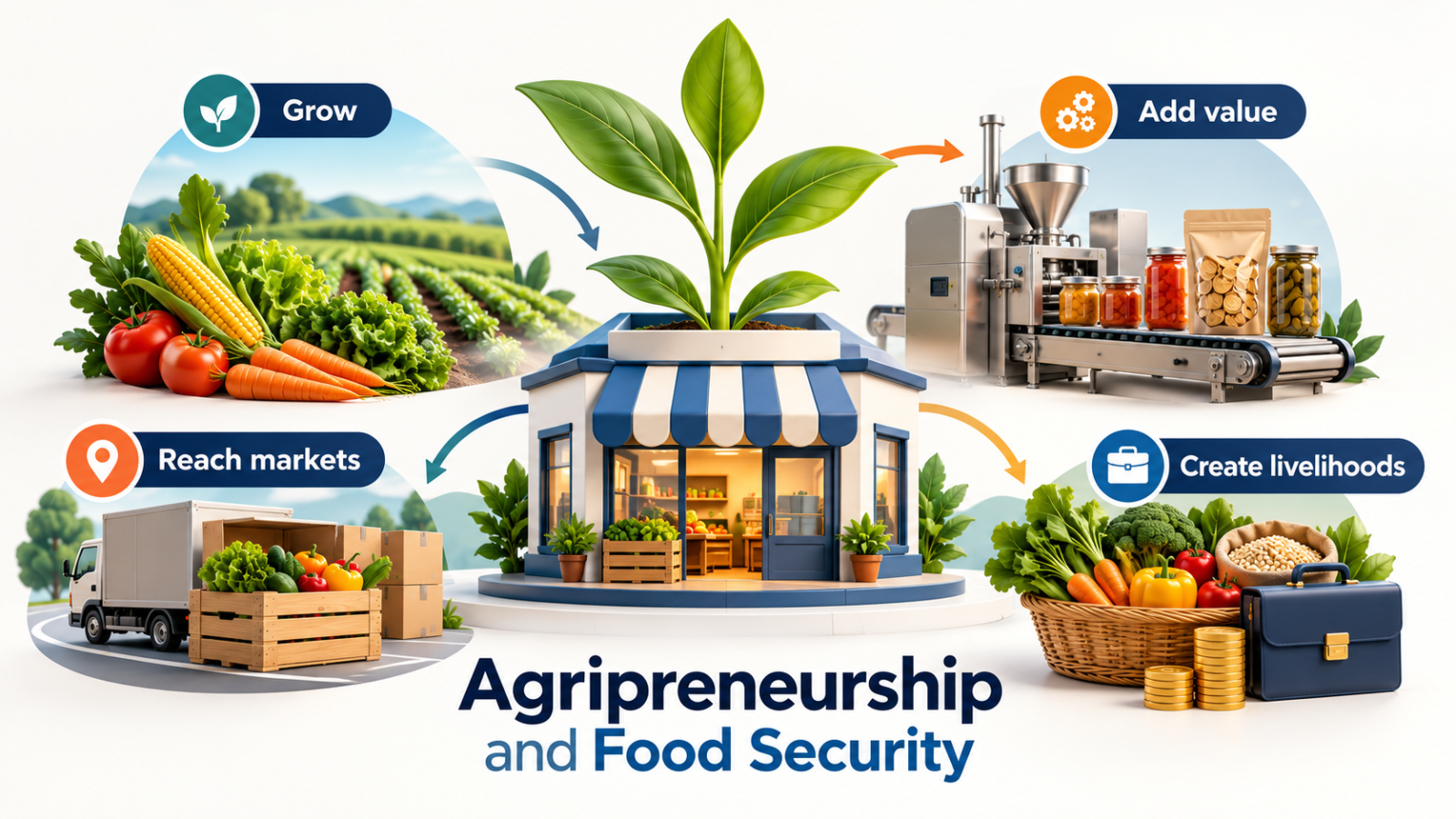
The webinar aimed to broaden participants’ understanding of agripreneurship and help them recognise opportunities throughout the agricultural value chain. It explored how businesses can address food system challenges by reducing losses, connecting producers to markets, adding value to agricultural products and providing essential services.
The session also aimed to help participants connect enterprise development with food security and employment. It highlighted the importance of combining practical skills, access to finance, productive assets and market connections to support businesses that can operate sustainably and respond to disruption.
Antecedentes
The webinar “Agripreneurship as an Opportunity for Food Security” formed part of the UNITAR RISE-LAB 2026 learning journey. The presentation by Viola Moyo and Kenneth Munyengerwi of ForAfrika South Sudan explored how enterprises across agricultural and food systems can improve food security while creating income, employment and viable livelihoods.
Building on an earlier session on food security, the webinar examined business opportunities beyond primary production. It showed how gaps in input supply, preservation, transport, processing and market access can become opportunities for enterprises that respond to customer demand. Examples from South Sudan illustrated approaches that could also be adapted to Sudan’s operating context.
Objetivos del aprendizaje
By the end of the webinar, participants were expected to be able to:
- Define agripreneurship and explain how it extends beyond farming to businesses and services across the food system.
- Identify enterprise opportunities in input supply, aggregation, storage, transport, processing, marketing and advisory services.
- Explain how agricultural enterprises can improve food availability and access, generate income and strengthen livelihoods.
- Use the driver, opportunity, solution and enterprise framework to examine a potential business opportunity.
- Recognise the roles of skills development, savings groups and market connections in establishing viable enterprises.
- Identify practical measures to prepare for shocks, maintain business operations during disruption and adapt afterwards.
Contenido y estructura
The session introduced ForAfrika and its work in South Sudan before defining agripreneurship as the identification and development of profitable opportunities across agricultural and food systems. It explained that entrepreneurs can create value through products and services at any stage between input supply and food consumption.
The presentation then examined food security as a systems problem. It described how weak connections between producers, storage facilities, transport services, processors and markets contribute to food losses and higher costs. Fisheries provided an example of how improved handling, preservation and transport can help more food reach consumers and increase earnings.
Participants were introduced to a framework for identifying opportunities: understand the driver or gap, determine what is needed, identify a product or service that creates value, and consider who can deliver it sustainably and profitably. Examples included fish drying and smoking, vegetable preservation, aggregation services, machinery hire, tool fabrication and repair, and supplying locally produced food to schools. The session stressed that a gap becomes a business opportunity when a customer is willing to pay for a solution.
ForAfrika’s Dynamic Development Continuum illustrated how support can evolve from humanitarian assistance towards self-reliance and commercial viability. The presentation linked business promotion with Youth Employment and Enterprise Development, Village Savings and Loan Associations, and stronger connections between producers, service providers and buyers.
Practical cases included fisheries in Pibor, vegetable enterprises in Gogrial West, and crop production supported by a “Farming as a Business” approach. These examples showed how productive assets and training can contribute to food supply, household income and reinvestment. Further examples covered aggregation centres, communal storage, processing equipment, transport services and producer–trader connections.
The session explored how savings groups can provide capital for small enterprises such as groundnut processing, grain trading and food businesses. The youth employment examples demonstrated how technical and entrepreneurship training, combined with start-up support, can help establish agro-dealers and businesses that fabricate or repair agricultural tools. Home-Grown School Feeding illustrated how schools can provide a predictable market for local farmers while improving children’s access to nutritious food.
The final sections addressed business practices and resilience. Participants were encouraged to begin with customer demand, build on existing skills and networks, plan for reinvestment and diversify products and markets. A framework for responding to shocks covered preparation before a disruption, continuity during the shock, and recovery and adaptation afterwards.
The presentation concluded by considering how these approaches could be adapted to Sudan, recognising differences in conflict, climate, infrastructure and market conditions. It also connected agripreneurship with the value chain, introducing the focus of the next session, and provided space for questions and answers.
Metodología
The webinar combined conceptual explanations with practical cases from ForAfrika’s programmes in South Sudan. Food system mapping and the driver, opportunity, solution and enterprise framework provided a structured way to examine business opportunities.
Examples from fisheries, horticulture, crop production, savings groups, youth enterprise development and school feeding connected the concepts to livelihood challenges. Guiding questions encouraged participants to consider where value is being lost, what problem a business could solve and who would pay for the solution. The session included a questions and answers segment.
Público objetivo
Participants in the UNITAR RISE-LAB 2026 programmes for Sudan and South Sudan, including aspiring entrepreneurs and existing business owners interested in agricultural enterprises, food security and livelihood opportunities.
Información adicional
The presentation was delivered by Viola Moyo and Kenneth Munyengerwi of ForAfrika South Sudan on 11 September 2026. It emphasised that entrepreneurs can create livelihoods by providing services to farmers and other food businesses, as well as through farming itself.
The webinar contributes to UNITAR RISE-LAB 2026 by helping participants recognise viable enterprise opportunities that address food security challenges and support income generation and employment. The programme is delivered by UNITAR’s Division for Prosperity with support from the Government and People of Japan.
Protección de Datos y Privacidad
Los datos personales de los participantes que solicitan, se registran o participan en los cursos y otros eventos de UNITAR se rigen por la Política de Privacidad y Protección de Datos. Al solicitar, registrarse o participar en este evento, el participante reconoce que conoce dicha política y aceptan sus condiciones.