
Tipo
Workshop
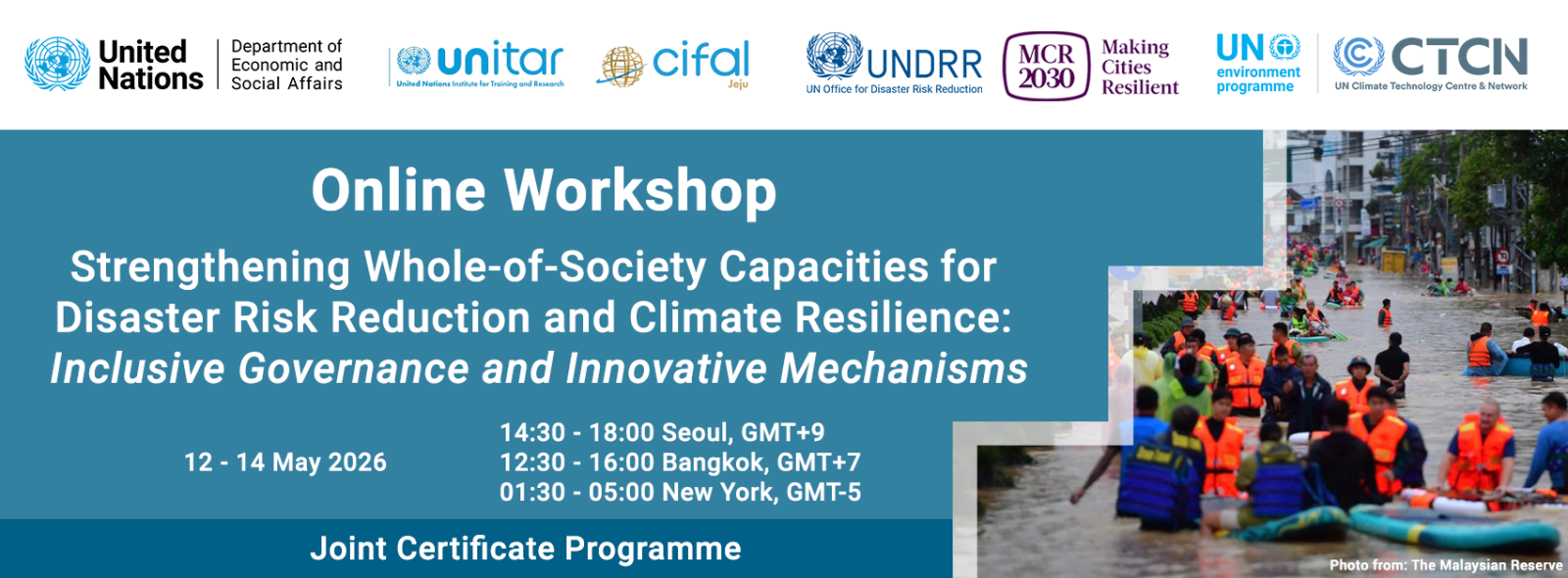
CIFAL Jeju - Strengthening Whole-of-Society Capacities for Disaster Risk Reduction and Climate Resilience: Inclusive Governance and Innovative Mechanisms
Ubicación
Web-based
Fecha
-
Duración
3 Days
Área del programa
Decentralize Cooperation Programme
Sitio web
Precio
0,00 US$
Correo Electrónico del Centro de Coordinación del Evento
hjlee.jitc@cifaljeju.org
Inscripción
Open-registration event
Tipo de aprendizaje
E-learning
Idioma(s)
English
Pilar
People
Colaboración
UN Office for Disaster Risk Reduction, Global Education and Training Institute (GETI), United Nations Department of Economic and Social Affairs (UNDESA), United Nations Institute for Training and Research (UNITAR), CIFAL Jeju, Making Cities Resilient 2030 (MCR2030), United Nations Environment Programme (UNEP)
Objetivos del evento
The online workshop will:
- Improve understanding of key DRR concepts and support localization and implementation of the Sendai Framework for DRR 2015-2030;
- Promote principles and strategies for inclusive DRR governance and planning;
- Enhance familiarity with Making Cities Resilient 2030 (MCR2030) resources and tools to enhance inclusive local resilience planning;
- Introduce strategic foresight thinking to facilitate stronger coordination, coherence and integration of climate action across multiple sectors;
- Enhance institutional and organizational capacities and strengthen policy planning to embrace strategic foresight methodologies, thereby facilitating sound policymaking for effective integration of climate action;
- Provide an overview of strategies for private sector engagement, emphasizing the strengthening of business resilience and mobilization of private capital for societal resilience. This includes disclosure frameworks to incentivize corporate risk management and the development of pipelines of bankable, investable resilience solutions; and
- Strengthen knowledge of emerging technologies supporting climate resilience to disaster risk and damage, with special attention to applied examples of automation and Artificial Intelligence (AI).
Antecedentes
The United Nations Department of Economic and Social Affairs (UN DESA), through the Division for Public Institutions and Digital Government (DPIDG) and its project office - United Nations Project Office on Governance (UNPOG), the United Nations Institute for Training and Research (UNITAR) CIFAL Jeju/Jeju International Training Center (JITC) and the UN Office for Disaster Risk Reduction (UNDRR) Office for Northeast Asia (ONEA) and Global Education and Training Institute (GETI) and Making Cities Resilient 2030 (MCR2030), in collaboration with the United Nations Environment Programme’s Climate Technology Centre and Network (CTCN), and with support from the Incheon Metropolitan City and the Ministry of the Interior and Safety (MOIS) and the Ministry of the Science and ICT (MSIT) of the Republic of Korea, will virtually organise the 6th Joint Certificate Programme of the Online Workshop on Strengthening Whole-of-Society Capacities for Disaster Risk Reduction and Climate Resilience: Inclusive Governance and Innovative Mechanisms on 12-14 May 2026.
The workshop will emphasize inclusive resilience-building through different gender-responsive and disability-inclusive DRR approaches, strengthening public institutions and policy planning by embedding strategic foresight methodologies for integrated climate action, and catalysing private sector engagement and leverage climate technologies for DRR and climate resilience.
The Workshop will introduce concepts, frameworks, and practical approaches to strengthen inclusive disaster risk reduction (DRR), climate resilience, and climate action through effective governance, risk-informed planning, private sector engagement, and technology-enabled solutions. It will provide participants a comprehensive understanding of disaster and climate risk, resilience, and effective governance for strengthening public institutions, while highlighting how these priorities can be translated into actionable measures across different levels of government and society.
Objetivos del aprendizaje
By the end of the online workshop, participants will have:
a) Understood the main concepts and global frameworks for coherent disaster risk reduction, climate resilience, and sustainable development governance at different levels of government and society;
b) Understood the principles and strategies for disability-inclusive and gender-responsive DRR;
c) Enhanced their understanding of MCR2030 tools supporting inclusive local risk reduction and resilience planning;
d) Improved comprehension on core concepts and practical approaches for embedding strategic foresight in public institutions to support integrated climate action;
e) Acquired a solid grasp of key foresight tools and methodologies and their application on policy planning and decision-making to support integrated climate action;
f) Acquired an understanding of approaches to engaging the private sector, with a focus on enhancing business resilience and leveraging private finance for societal resilience, including disclosure mechanisms to promote corporate risk management and the cultivation of pipelines of financially viable and investable resilience solutions;
g) Access to knowledge on concept-proven technologies supporting DRR and climate resilience.
Contenido y estructura
Session 1. Ensuring Inclusive Climate and Disaster Risk Reduction and Resilience: Key Concepts, Frameworks and Tools
- Introduced key concepts, global frameworks and approaches to inclusive disaster risk reduction and climate resilience
- Shared key considerations and approaches for putting gender-responsive and disability-inclusive DRR into action
Session 2. Embedding Strategic Foresight in Public Institutions for Climate Action
- Strategic foresight adds value to policymaking as it supports long-term, anticipatory policymaking under conditions of uncertainty.
- Foresight methods such as horizon scanning, futures wheel, Three Horizons, scenario planning, and backcasting can help identify emerging risks, opportunities, and pathways for action
Session 3. Unlocking Private Sector Engagement and Catalyzing Climate Technologies for Disaster Risk Reduction and Climate Resilience
- Physical climate risks directly affect the stability of the financial sector by increasing the likelihood of non-performing loans and challenging the capital adequacy of banking institutions.
- Strategic resilience for businesses is categorized into value preservation, which focuses on protecting existing assets from risk, and value generation, which identifies new market opportunities and improves access to capital.
- AI for ALL Artificial intelligence has become a technology for everyone, no longer limited to specific individuals or fields.
- "ClimaX" AI transforming climate change response, more effective and quickly AI-based automated tools contribute to improving climate resilience and DRR (Rapid Assessing & Alert, Optimizing Solutions etc.)
Metodología
The training will consist of lectures and thematic presentations by experts, case study presentations, interactive Q&A discussions, and knowledge check quizzes and exercises.
Público objetivo
This training is open to national and local government officials including SDGs, Sendai Framework, climate and urban development focal points and other stakeholders from national government, civil society and institutions in Asia-Pacific and beyond interested in or supporting inclusive climate and disaster risk reduction and resilience approaches, risk-informed governance mechanisms and innovative partnerships and technologies for risk reduction, climate action and sustainable development.
Protección de Datos y Privacidad
Los datos personales de los participantes que solicitan, se registran o participan en los cursos y otros eventos de UNITAR se rigen por la Política de Privacidad y Protección de Datos. Al solicitar, registrarse o participar en este evento, el participante reconoce que conoce dicha política y aceptan sus condiciones.