
Tipo
Workshop
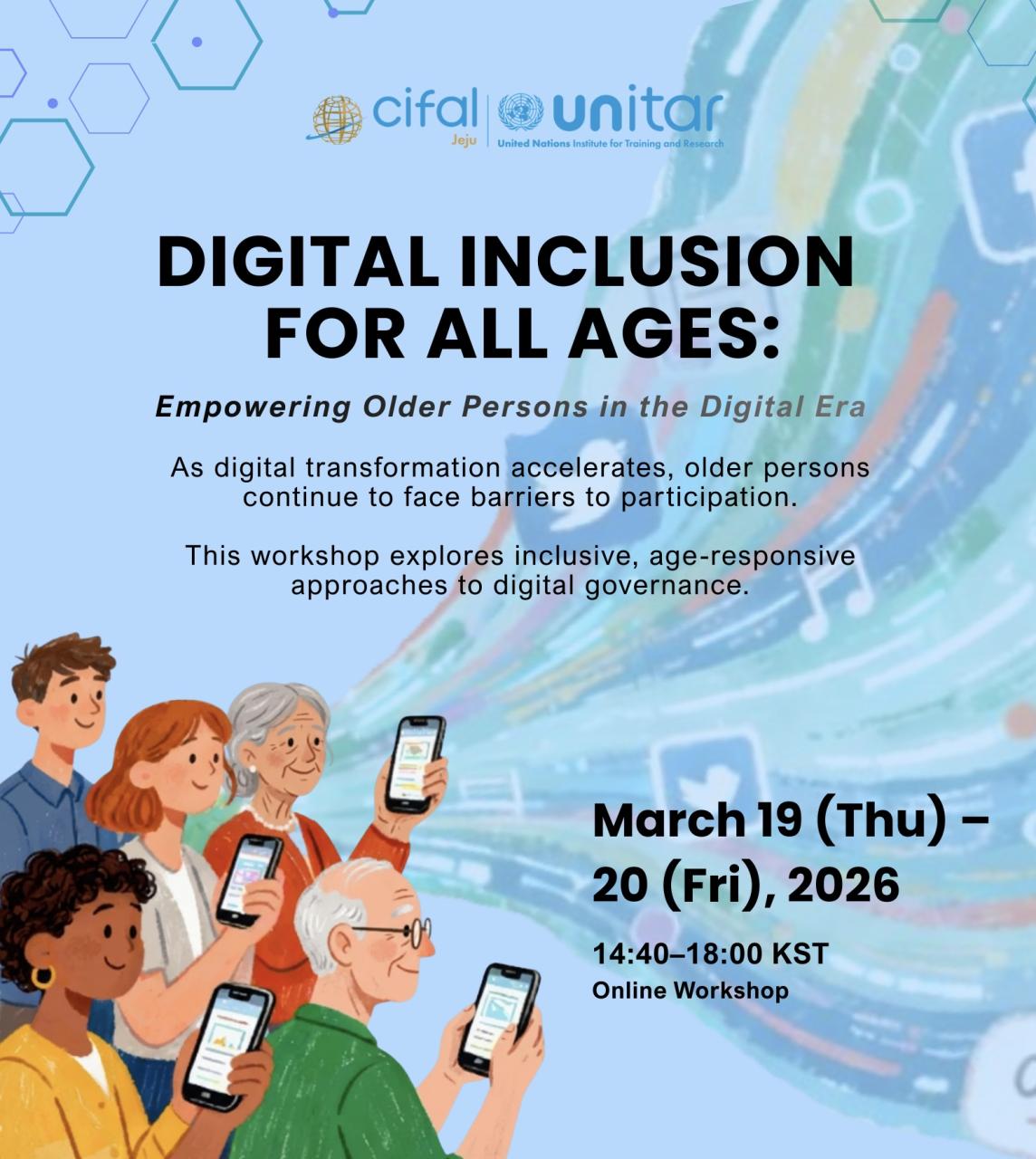
CIFAL Jeju - Digital Inclusion for All Ages: Empowering Older Persons in the Digital Era
Ubicación
Web-based
Fecha
-
Duración
6 Hours
Área del programa
Decentralize Cooperation Programme
Sitio web
Precio
0,00 US$
Correo Electrónico del Centro de Coordinación del Evento
cifalnetwork@unitar.org
Inscripción
Open-registration event
Tipo de aprendizaje
E-learning
Idioma(s)
English
Pilar
People
Colaboración
CIFAL Jeju (574), CIFAL Jeju (574)
Objetivos del evento
This capacity building training workshop will:
- Examine barriers to digital inclusion for older persons, including gaps in access, digital literacy, technology design, and supportive policies;
- Analyze age-inclusive policy frameworks and global best practices to derive actionable insights for national and regional strategy development;
- Review successful digital literacy models and educational programs tailored to older learners, identifying key success factors for effective skill-building;
- Explore age-friendly design principles and case studies of intuitive digital interfaces that accommodate the cognitive and sensory needs of older users;
- Understand the role of multi-stakeholder partnerships between policymakers, tech developers, and civil society to co-create a sustainable ecosystem for digital equity.
Antecedentes
The world is undergoing demographic transition at an unprecedented pace. In the Asia-Pacific region specifically, it is estimated that one in four people will be over the age of 60 by 2050. Concurrently, digital technologies are becoming essential infrastructure for accessing healthcare, participating in economic life, and engaging in civic activities. For older persons, this digital transformation presents both transformative opportunities and structural challenges.
Despite progress in expanding digital access across the region, a persistent age-based digital divide between generations continues to exclude many older persons from full participation in the digital age. Indeed, in most countries with available data, Internet use among young people is near universal, whereas the share of older persons—especially those aged 75 and above—who are online remains low or very low in all but one economy in the region[1].
However, limited Internet access represents only the first layer of exclusion. Even in digitally advanced contexts such as South Korea, where connectivity and device ownership have become nearly universal, older persons continue to face a second, deeper divide related to digital literacy and effective use. According to 2024 data, the digital literacy level among older persons stands at only 55.9 per cent[2], markedly lower than other digitally vulnerable groups[3]. This capability wall arises because digital environments are primarily designed for younger, digitally fluent users, with interfaces and navigation patterns that assume prior familiarity. Older persons must contend with unclear instructions, overwhelming options, and heightened concerns around online security and privacy. Without age-appropriate training and support, this mismatch generates anxiety and fear of making costly mistakes, ultimately reinforcing exclusion from essential services such as e-governance, digital banking, and telehealth.
Beyond moral imperatives, addressing digital inclusion for older persons directly advances the Sustainable Development Goals, particularly SDG 10 (Reduced Inequalities), SDG 8 (Decent Work and Economic Growth), and SDG 16 (Peace, Justice, and Strong Institutions). It requires comprehensive strategies that combine infrastructure development, accessible design, digital literacy programs, and collaborative partnerships across sectors.
This workshop brings together policymakers, technologists, educators, and civil society from across the Asia-Pacific region to strengthen responses to digital exclusion affecting older persons through collaborative learning and evidence-based exchange. Participants will build practical understanding of the structural, policy, and skills-related barriers that limit older persons’ digital participation, examine solutions that have proven effective across diverse contexts, and explore how partnerships and resources can be mobilized to sustain progress. Through this process, the workshop aims to equip participants with actionable strategies to advance digital equity for older persons at the regional and organizational levels, ensuring that digital transformation benefits all generations.
Objetivos del aprendizaje
By the end of the workshop, participants will be able to:
- Identify the main barriers preventing older persons from accessing and using digital technologies, including gaps in infrastructure, skills, and confidence;
- Integrate insights from proven policy approaches from other countries to strengthen local and/or national digital inclusion plans;
- Design digital literacy programs tailored to the learning needs and preferences of older adults;
- Advocate for age-friendly design standards within their organizations to make digital platforms accessible and easy to use for all ages.
Contenido y estructura
Day 1 – March 19, 2026
- Opening Session
- Lecture 1: Digital Silver Rights – Why Age Matters in the Digital Era
- Lecture 2: Digital Literacy Strategies for Older Persons at National, Local, and Community Levels
- Lecture 3: From Digital Access to Digital Confidence – The YoungHappy Model for Older Adults
- Q&A Sessions and Interactive Discussions
Day 2 – March 20, 2026
- Recap of Day 1
- Lecture 4: AI and Emerging Technologies – Supporting Digital Inclusion for Older Persons
- Lecture 5: Accessibility Standards and Universal Design Principles
- Lecture 6: Public-Private Partnerships for Digital Inclusion
- Closing Session
Each lecture includes Q&A and interactive exchange to facilitate applied learning and knowledge-sharing.
(Programme subject to change.)
Metodología
- Expert-led lectures
- Evidence-based policy analysis
- Interactive Q&A discussions
- Case study presentations
- Cross-regional knowledge exchange
- Multi-sector dialogue
The workshop integrates theoretical frameworks, policy review, and practical implementation strategies to ensure applicability across diverse national contexts.
Público objetivo
This workshop is open to stakeholders from diverse sectors who are engaged in advancing digital inclusion for aging populations. Participants may include representatives from governments, civil society organizations, international organizations, academia, and the private sector working on issues related to digital policy, aging and social protection, technology development, human rights, and sustainable development—particularly in alignment with SDG 8 (Decent Work and Economic Growth), SDG 10 (Reduced Inequalities), and SDG 16 (Peace, Justice, and Strong Institutions).
Protección de Datos y Privacidad
Los datos personales de los participantes que solicitan, se registran o participan en los cursos y otros eventos de UNITAR se rigen por la Política de Privacidad y Protección de Datos. Al solicitar, registrarse o participar en este evento, el participante reconoce que conoce dicha política y aceptan sus condiciones.