
UNITAR Online Catalogue
UNITAR RISE-LAB 2026 South Sudan Phase Two: (Webinar 3) Tromso Case Study on Circular Agriculture and Biochar (Japanese Start-up)
Prosperity
背景信息
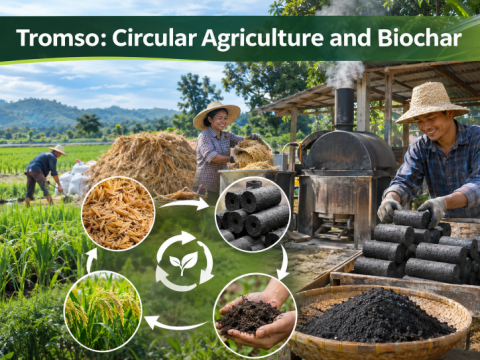
The Tromso Co., Ltd. presentation introduced a Japanese company’s approach to transforming agricultural residues into useful products and business opportunities. Based in Innoshima, Hiroshima Prefecture, Tromso described its work in two interconnected areas: “Protecting Greenery” through rice-husk solid fuel, and “Nurturing Greenery” through biochar for agricultural use and potential carbon-credit generation.
The company framed the issue as a connection between waste disposal, deforestation, soil degradation, agricultural productivity, climate impacts and rural livelihoods. Its experience in countries including Tanzania and Vietnam was used to illustrate the potential of circular resource use, where locally available agricultural by-products become inputs for energy, farming and new enterprise activities. The presentation served as a practical private-sector case study of sustainability-oriented innovation rather than a step-by-step technical training course.
活动目标
The session aimed to expose participants to a real-world example of creating economic and environmental value from agricultural waste. It illustrated how an enterprise can begin with an observed local problem, develop suitable processing technology, build partnerships and design a business model around the resource being underused.
It also aimed to introduce the basic distinction between agricultural-residue fuel and biochar, explain the potential agricultural and climate-related applications of biochar, and demonstrate the importance of field testing, feedstock selection, technical analysis, farmer support and financing in moving from an idea to a scalable sustainable business.
学习目标
By the end of the presentation, participants were expected to be able to:
- Describe the environmental, agricultural and livelihood problems associated with unused agricultural residues.
- Distinguish rice-husk fuel briquettes from biochar and recognise the separate business purposes of the two products.
- Explain in basic terms how agricultural biomass can be converted to biochar and why it is considered for soil improvement and longer-term carbon storage.
- Identify potential business opportunities across residue collection, conversion equipment, farmer advisory services, analysis and carbon-credit value chains.
- Recognise the importance of testing biochar under relevant soil, crop and feedstock conditions rather than assuming universal benefits.
- Explain why partnerships, operational capacity, monitoring and market access matter when expanding an agricultural technology business.
- Consider whether a locally available waste stream could become the starting point for a practical circular-agriculture idea.
内容和框架
The presentation opened with Tromso’s mission and corporate experience, explaining that agricultural residues are often discarded while communities face pressure from fuel demand, land degradation and insecure farming incomes. Founded in 1994 in Innoshima, the company described a transition from manufacturing into environmental and agricultural solutions. Its profile covered equipment manufacturing, farmer consulting, demonstrations and related carbon-credit activities.
The “Protecting Greenery” section presented Tromso’s Grind Mill equipment for producing solid fuel briquettes, known as Momigalite, from rice husks and certain other residues. The company used its work in Tanzania to illustrate how locally produced fuel could make better use of rice-milling by-products and offer an alternative to firewood or charcoal. The presentation also described equipment installation, training for local operation and maintenance, and the sale of processing machinery as part of the business model.
The “Nurturing Greenery” section introduced biochar, a carbon-rich material produced by heating biomass under oxygen-limited conditions. The company discussed using residues such as rice husks, peanut shells, bark and other organic by-products. Potential benefits described in the presentation included improved soil water retention, nutrient management, reduced dependence on some fertiliser inputs and longer-term storage of carbon when biochar is appropriately produced and applied.
The session connected these potential benefits with carbon dioxide removal and carbon-credit markets. It described the idea of measuring and quantifying carbon storage so that climate-related outcomes can potentially create an additional revenue stream. The presentation’s diagrams linked biomass conversion, use in agricultural land, soil benefits and carbon credits. These were presented as a business opportunity subject to appropriate measurement, verification and market arrangements, not as guaranteed revenue for every project.
Tromso then described its research, development and agricultural-support activities. Its continuous biochar production equipment was presented as adaptable to different feedstocks and operating conditions. The company also described cultivation trials, soil and greenhouse-gas analyses, fertiliser planning support and its Biochar R&D Center in Innoshima. The presentation explicitly noted that biochar performance varies by raw material, soil and crop, and that some cultivation trials had shown unfavourable as well as favourable outcomes. This highlighted the need for local adaptation and testing.
The business-model section described an integrated service approach spanning equipment, biochar production, farming support, testing and analysis, and carbon-credit development. Examples of activities and partnerships in Japan, Vietnam and other countries illustrated how technical innovation relies on feedstock supply, local partners and farmer adoption. A case involving cacao husks in Vietnam showed a planned approach to combining residue conversion, soil improvement and recovery of process heat. The final slides discussed business expansion, partnerships and longer-term growth plans.
方法
The presentation used a company case-study format supported by photographs, equipment illustrations, explanatory diagrams, research and cultivation-trial descriptions, business-model visuals and international project examples. These materials demonstrated how a sustainability problem can be translated into a technical product and then into a broader system of services and partnerships.
The supplied slides do not describe a specific chat exercise, facilitated participant activity or scored assessment. For EMS purposes, the intended learning method is therefore best described as an expert or corporate case presentation with opportunities to reflect on applications in participants’ own agricultural and business contexts, rather than as a practical exercise that was explicitly conducted.
目标受众
Participants in UNITAR RISE-LAB 2026, particularly aspiring entrepreneurs, agribusiness owners, agricultural innovators and development practitioners in Sudan and South Sudan who are interested in agricultural waste utilisation, sustainable production, circular business models and climate-related enterprise opportunities.
更多信息
The presentation was provided by Tromso Co., Ltd., a Hiroshima Prefecture-based company. It included examples from Tanzania, Japan and Vietnam and descriptions of its technologies, international projects and commercial development plans. The slide deck was titled as a company overview and does not identify a specific individual as the presenter.
Performance benefits, commercial forecasts and future expansion plans described in the slides are company-provided information. They should be treated as illustrative case-study material, not as independently verified outcomes or promises of comparable results in Sudan or South Sudan. The case reinforces the RISE-LAB themes of practical innovation, sustainability and building viable businesses around real community problems.