
UNITAR Online Catalogue
UNITAR RISE-LAB 2026 South Sudan Phase One: (Webinar 1) Problem-Solution Fit
Prosperity
背景信息
The webinar “Problem-Solution Fit” was delivered on 13 August 2026 as part of the Phase One learning journey of UNITAR RISE-LAB 2026. The session was facilitated by Dr Clare Gately and focused on helping participants move from having a business idea to gathering evidence that a real customer problem exists and that their proposed solution can meaningfully address it.
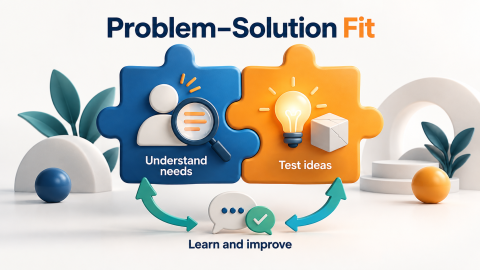
The webinar defined problem-solution fit as the validation stage in which an entrepreneur demonstrates both that a meaningful customer problem exists and that the proposed product or service has the potential to solve that problem successfully.
活动目标
The webinar aimed to help participants approach entrepreneurship as a process of testing and learning rather than immediately investing significant resources in an unvalidated business idea. It sought to enable participants to identify assumptions within their proposed business models, determine which assumptions create the greatest risk, and design practical experiments to test them.
The session also aimed to strengthen participants’ ability to validate customer problems, test proposed solutions, collect evidence from potential customers, and use that evidence to make informed decisions about whether to continue, improve or change a business idea.
学习目标
By the end of the webinar, participants were expected to be able to develop an experimentation sequence for testing and validating a start-up idea toward problem-solution fit. Participants were encouraged to determine whether they could demonstrate that a real customer problem exists, identify how their proposed product or service could be validated, and recognize the evidence required to determine whether problem-solution fit had been achieved.
内容和框架
The session began by introducing the concept of problem-solution fit and emphasizing three core validation activities: problem validation, solution testing and behavioural alignment. Participants were encouraged to speak directly with target users to determine whether the identified problem is sufficiently frequent, urgent or costly; use early mock-ups or prototypes to test whether the proposed solution performs better than existing alternatives; and determine whether the proposed solution fits naturally into customers’ existing behaviour and practices.
The webinar then explored the types of evidence that indicate progress toward problem-solution fit. These included clear confirmation from customers that the identified problem reflects their real experience, engagement from early adopters who are willing to test prototypes or minimum viable products, and stronger commitment signals such as positive feedback or willingness to pay.
Participants were introduced to the idea that an early-stage start-up is essentially an experiment searching for a workable business model. The session therefore emphasized testing ideas before committing significant resources. Different areas of business risk were introduced through the dimensions of desirability, feasibility, viability and impact, encouraging participants to begin by determining whether customers actually want and value the proposed offering.
The webinar introduced an experimentation process in which participants identify and prioritize their riskiest assumptions, break their ideas into smaller testable hypotheses, conduct experiments, examine the resulting evidence and continuously revise their business model. The presentation emphasized that experimentation can reduce risk and uncertainty and support a more informed decision on whether to pivot, persevere or pause an idea.
A practical B2B experimentation sequence was presented, beginning with customer interviews and problem definition, followed by qualitative validation and early “smoke tests,” and progressing toward stronger commercial commitment through letters of intent or paid pilot testing. Participants were encouraged to establish clear success and failure criteria before undertaking each experiment.
The session used a refrigerated food and beverage distribution and logistics concept as a practical case example. Participants were shown how assumptions about high distribution costs and the potential benefits of improved cooling and logistics could be tested through customer interviews, market-interest testing, low-fidelity prototypes and commitment from potential customers.
The example then progressed through problem-validation interviews, a solution-validation test and a behavioural or commercial commitment test. Suggested evidence included customers ranking the problem among their most significant operational challenges, asking about pricing or trial participation, and signing letters of intent or providing inventory for a test.
The webinar concluded by reinforcing several key messages: entrepreneurs should speak directly with customers, use evidence rather than assumptions, use experimentation to reduce uncertainty, and approach entrepreneurial decision-making with the mindset of a scientist.
方法
The webinar used a highly practical and experimentation-oriented methodology. Conceptual explanations were combined with reflection questions, worked examples, sequential experiments and a detailed business case demonstrating how an idea could move from problem identification to customer validation and early commercial commitment.
Participants were repeatedly encouraged to apply the concepts to their own entrepreneurial ideas by asking what assumptions they were making, what evidence they would need, who they should speak to and what simple experiment could be conducted before investing further resources.
The session also introduced digital tools that may support early market research and experimentation, including online search-trend and keyword tools and AI-supported customer-persona development.
目标受众
Participants from Sudan and South Sudan who applied for both training programmes.
更多信息
The webinar was facilitated by Dr Clare Gately on 13 August 2026. The session reinforced the practical and evidence-based approach of RISE-LAB by encouraging participants to test assumptions early, learn directly from customers and progressively reduce the risks associated with developing a new enterprise or solution.
The webinar contributes to the wider objectives of UNITAR RISE-LAB 2026 by strengthening participants’ entrepreneurial decision-making, customer understanding and ability to develop viable solutions to real livelihood and market challenges. The programme is delivered by UNITAR’s Division for Prosperity through the RISE-LAB team with support from the Government and People of Japan.