
UNITAR Online Catalogue
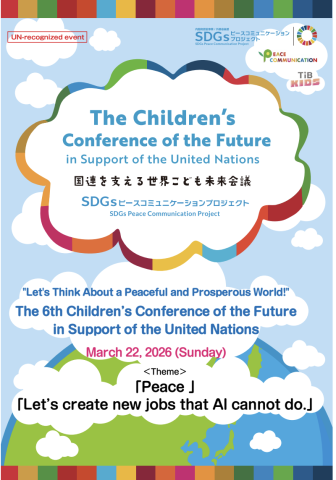
CIFAL Japan - The Children’s Conference of the Future in Support of the United Nations
People
Ministry of Foreign Affairs (Japan), Ministry of Children, Families and Gender Equality, CIFAL Japan, Peace Communication Foundation, Tokyo Metropolitan Government
背景信息
The Children’s Conference of the Future in Support of the United Nations is a UN-recognized child-centered initiative designed to empower children as active agents of change.
Held previously during EXPO 2025 (Future Summit) and continuing through its 6th edition in 2026, the conference brings together children from Japan and around the world to discuss global challenges grounded in the Sustainable Development Goals (SDGs).
The 2026 theme:
- “Peace”
- “Let’s create new jobs that AI cannot do.”
- “Let’s Think About a Peaceful and Prosperous World!”
The conference positions children not as passive learners but as leaders who communicate proposals and declarations to adult society. It emphasizes diversity & inclusion (DE&I), social inequality, gender equality, technological transformation, and peace-building.
On Hiroshima Peace Memorial Day (August 6, 2025), children presented the “Peace Communication Declaration,” marking the 80th anniversary of the end of World War II. This declaration continues to inform the 2026 program’s peace-focused dialogue.
活动目标
- To empower children as key actors in shaping future society.
- To promote peace education aligned with global SDGs.
- To encourage children to critically reflect on AI, future jobs, and social transformation.
- To strengthen dialogue between children, policymakers, educators, and international institutions.
- To foster diversity, inclusion, and global citizenship.
-
To connect children’s voices to policy and international discourse.
Participants will:
- Develop critical thinking skills related to peace, AI, and future employment.
- Understand SDGs in practical, social contexts.
- Learn collaborative dialogue through workshop-based engagement.
- Practice presentation and public speaking skills.
- Reflect on personal responsibility in contributing to peaceful societies.
- Explore future-oriented thinking and creative problem-solving.
内容和框架
Opening Ceremony
Speeches from:
- Director, UNICEF Tokyo Office
- Mayor of Chiyoda City
- National Diet Members Supporters Club Leaders
Part 1 – Workshop Sessions
- Self-introduction using “Cards for Collective Wellbeing”
- Discussion on “Peace” and “AI”
- Creation of presentation sheets
LunchPart 2 – Presentations
Children present their ideas on:
- Peacebuilding
- AI and future employment
- SDGs and social responsibility
Part 3 – Entertainment & Experiential Program
- Digital entertainment stage
- DE&I Future Stage (NTT Corporation)
- Technology-enhanced communication tools
- Interactive experiential booths
Closing Ceremony
方法
- Child-centered participatory learning
- Workshop-based collaborative dialogue
- Presentation-based peer learning
- Technology-enhanced engagement (digital tools, communication cards)
- Experiential exhibition booths
- Intergenerational dialogue (children and policymakers)
- Simultaneous bilingual interpretation
The program integrates peace education, SDG awareness, digital literacy, and leadership development through experiential learning.
目标受众
- Elementary and middle school students
- Youth leaders
- Educators
- Policymakers and government representatives
- International stakeholders
- Corporate CSR partners
更多信息
- UN-recognized event
- Supports SDG 4 (Quality Education), SDG 16 (Peace, Justice & Strong Institutions), SDG 5 (Gender Equality), SDG 10 (Reduced Inequalities)
- Simultaneous interpretation (Japanese–English)
- Post-EXPO initiatives include:
- Establishment of online platform for year-round children’s dialogue
- Mini Future Summits in regional and overseas locations
- School-based SDG and peace education collaboration
- Documentary and educational video production
- Strengthened partnerships with UNICEF, UNESCO, and international organizations
The most significant achievement of the event is reinforcing the principle that:
“Children are the key actors in creating the future society.”