
UNITAR Online Catalogue
The United Nations Climate Change Study Programme
Planet
Contexte
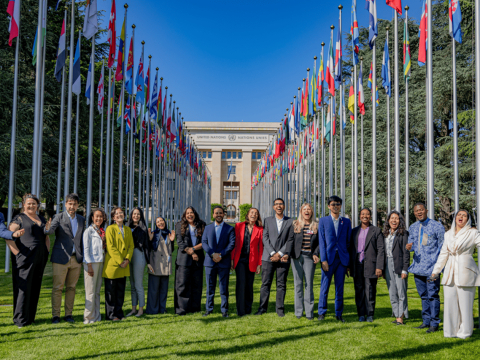
The United Nations Climate Change Study Programme offers participants a unique opportunity to engage directly with the global institutions, experts, and practitioners shaping international climate policy and sustainable development.
The United Nations Institute for Training and Research (UNITAR) was established in 1963 as an autonomous body within the United Nations with the mandate of enhancing the effectiveness of the work of the United Nations and its Member States through capacity development, research, and knowledge sharing.
Through its Division for Planet, UNITAR supports governments and stakeholders worldwide in advancing sustainable development, climate action, and environmental governance. UNITAR’s Green Development and Climate Change Programme develops and delivers capacity-building initiatives that strengthen knowledge and skills on climate change, green transitions, climate leadership, and the implementation of sustainable solutions.
Geneva represents one of the world’s leading centres for climate diplomacy, international cooperation, science, and sustainable development. The city hosts numerous United Nations agencies, international organizations, research institutions, and initiatives working on climate change, including the United Nations Framework Convention on Climate Change (UNFCCC), Intergovernmental Panel on Climate Change (IPCC), World Meteorological Organization (WMO), United Nations Environment Programme (UNEP), International Labour Organization (ILO), International Telecommunication Union (ITU), and other actors advancing climate action and green development.
By bringing together expertise from across International Geneva, the programme provides participants with first-hand exposure to the institutions and processes shaping global climate policy.
Objectifs du cours
The programme aims to:
- Strengthen participants’ understanding of global climate governance, climate science, and green development approaches.
- Provide insights into international climate agreements, including the Paris Agreement, Nationally Determined Contributions (NDCs), and global climate cooperation mechanisms.
- Build knowledge of practical approaches for climate mitigation, adaptation, resilience, sustainable finance, and a just transition.
- Develop participants’ understanding of the role of international organizations, research institutions, governments, and other stakeholders in advancing climate action.
- Provide opportunities for professional networking and career development within the United Nations system and related international organizations.
Objectifs d'apprentissage
Upon completion of the programme, participants will be able to:
- Discuss the role of the UN system and International Geneva in climate governance, environmental diplomacy and future global climate cooperation.
- Explain how the UNFCCC process, the Paris Agreement, and climate policy shape global climate action.
- Present key climate science concepts, data, and findings relevant to climate decision-making and action.
- Compare climate-related challenges and emerging solutions across key sectors, including health, water, food systems, energy, and cities.
- Assess how public and private finance, green skills, responsible innovation and digital technologies can enable climate action and support a just, inclusive and effective green transition.
- Engage with Geneva-based international organizations, experts and stakeholders to identify opportunities for continued learning, collaboration, and professional networking.
Contenu et structure
The programme combines:
- Expert lectures from Geneva-based United Nations agencies, international organizations, and climate experts.
- Technical and policy workshops.
- Interactive simulations and case-study discussions.
- Guided institutional visits.
- Career insights and networking sessions.
Méthodologie
The programme is designed to be highly interactive and participatory. Activities include:
- Expert presentations and keynote discussions.
- Hands-on exercises and policy simulations.
- Case-study analysis.
- Group discussions with climate practitioners and international experts.
- Institutional visits providing direct exposure to International Geneva.
All sessions will be conducted in English.
Audience cible
The programme is open to participants interested in climate change, green development, sustainable development, and international cooperation, including:
- Students and recent graduates.
- Young professionals and early-career practitioners.
- Government officials and policymakers.
- Representatives from international organizations and development agencies.
- Private sector professionals working in sustainability, climate finance, ESG, and innovation.
- Civil society organizations, NGOs, researchers, academics, and think tank representatives.
A maximum of 30 participants will be accepted on a first-come, first-served basis.
Participants completing the programme will receive a UNITAR Certificate of Completion.
Informations supplémentaires
UNITAR will be responsible for the overall design, coordination, and implementation of the Study Programme. It will liaise with participants on a regular basis prior to the activity's implementation in order to ensure a smooth and organization for everyone involved.
The participants are responsible for purchasing their own travel tickets to and from Geneva, as well as applying for a visa to Switzerland. UNITAR can support this process with the help of an official visa invitation letter. Participants further need to take care of their own accommodation and daily meals.
UNITAR will sponsor a welcome dinner for the participants, a welcome package including relevant training materials, and entry tickets to sights and museums. For further inquiries, kindly email climate.change [at] unitar.org (climate[dot]change[at]unitar[dot]org).
Please read this before registration: "I understand that the United Nations Institute for Training and Research (UNITAR) does not insure participants in the above-described activity, and I am advised to arrange at my own expense insurance against sickness, accident, permanent or temporary disability, death, and third-party risk for the period of the meeting, including travel time".
In the event that an insufficient number of participants have registered, UNITAR reserves the right to amend the dates of the scheduled programme. The delivery of the workshop is subject to a minimum of 20 participants, with a maximum of 30 participants to be accepted on a first-come, first-served basis.