UNITAR Online Catalogue
Executive Diploma in Sports Diplomacy
Multilateral Diplomacy
Contexte
In 2026, global sport will once again command unprecedented international attention, with major events such as the Winter Olympics, FIFA World Cup, Dakar Youth Olympics and Commonwealth Games bringing together billions of viewers and millions of spectators across borders. As one of the most influential and widely followed sporting competitions in the world, the FIFA World Cup in particular, co-hosted across three nations, showcases not only elite athletic performance but also serve as a powerful, and highly scrutinized platform for international engagement, cultural exchange, and global visibility.
Events such as the FIFA World Cup and the Olympic Games demonstrate that mega sporting events increasingly extend beyond the field of play. They highlight the growing role of sport as a reflection of the host’s image, a conduit for diplomatic promotion, functioning as an important instrument of soft power and foreign policy. Governments, international organisations, and non-state actors alike are leveraging sport to shape narratives, build partnerships, and address complex global challenges.
Against this backdrop, professionals must be equipped with the cultural awareness, strategic insight, and leadership skills needed to navigate the intersection of sport and diplomacy. While football provides a highly accessible and globally resonant entry point for examining these dynamics, the lessons, simulations, and frameworks explored in this programme are deliberately designed to be transferable across sporting disciplines. This ensures that participants can apply their knowledge across a wide range of sporting contexts, ensuring both relevance and adaptability.
Objectifs d'apprentissage
By the end of the programme, participants will be able to:
- Contrast, define and explain different types of leadership in international sports fields;
- Illustrate the crucial role of sports in public and cultural diplomacy;
- Evaluate the role of major sports bodies and initiatives in shaping national, regional, and international collaboration;
- Analyse how sports initiatives support multilateralism, and influence peacebuilding and social development outcomes;
- Critically assess roadmaps for delivering mega sporting events that maximise their long-term soft power benefits.
Contenu et structure
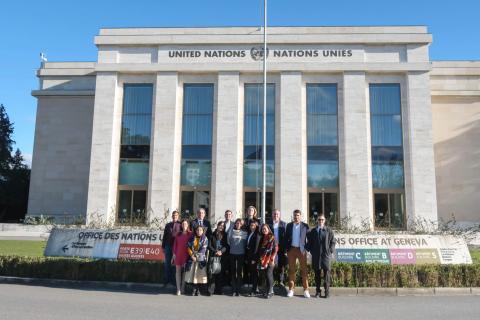
The Executive Diploma in Sports Diplomacy is designed to take place over five days in total, combining interactive training workshops and field visits to relevant international organisations or sporting associations in the Lake Léman Region (Geneva, Mies, Nyon, Lausanne). The programme will provide a high-level introduction into the field of sports diplomacy, with the following envisioned workshops included:
- Navigating the New World Order of Sport;
- Sport, Soft Power, and Diplomatic Influence;
- The Sport Diplomat’s Toolkit: Key Skills and Competencies;
- Mega Events, Human Rights & Responsible Sport;
- Consolidating Insights: Delivering Legacy in Sport.
As part of the programme, participants will have exclusive access to a high-level roundtable with senior officials from international sport federations - a rare opportunity for direct dialogue with the leaders shaping the future of global sport.
Organisations or sport federations potentially featured in the programme may include:
- International Federation of Football Associations (FIFA);
- The Union of European Football Associations (UEFA);
- The Centre for Sport and Human Rights (CSHR);
- The Court of Arbitration for Sports (CAS);
- International Basketball Federation (FIBA);
- The International Olympic Committee (IOC);
- International Canoe Federation (ICF);
- International Boxing Association (IBA);
- United Nations High Commissioner for Refugees (UNHCR);
- United Nations Office of the High Commissioner for Human Rights (OHCHR);
- World Anti-Doping Agency (WADA).
Méthodologie
The Executive Diploma in Sports Diplomacy is designed to be interactive and participatory, with case studies, interactive exercises including simulations, and group discussions during the training workshops. Participants will actively engage in problem-solving activities, share insights, and apply their knowledge to real-world scenarios. The interactive approach fosters collaboration, critical thinking, and practical skill acquisition for participants' engagement in the field of sports diplomacy.
The workshops are complemented by visits and curated introductions to the work of key sporting organisations and federations. Field visits allow participants to interact with these organisations and apply their knowledge in real-world contexts.
This holistic approach, incorporating concept learning, experiential activities, and reflective exercises, ensures participants acquire both theoretical knowledge, and practical skills to excel in sports diplomacy.
Audience cible
The Executive Diploma in Sports Diplomacy addresses the needs of a group of approximately 25 participants, welcoming:
- Working professionals in national or international sporting federations or associations;
- Local, regional and national government officials and diplomats;
- Athletes and sportspeople;
- International civil servants;
- NGO representatives;
- Private sector professionals;
- Recent graduates of an advanced university degree.
Informations supplémentaires
See the following link to hear from past participants of the programme: https://www.youtube.com/watch?v=fQEPfZ8IcAQ&feature=youtu.be
Insurance Waiver:
By applying to the Executive Diploma in Sports Diplomacy, all participants confirm that they are aware that the United Nations Institute for Training and Research (UNITAR) does not insure participants for this course. All participants are advised to arrange at their own expense insurance against sickness, accident, permanent or temporary disability, death, and third-party risk for the period of the diploma including travel time.
Certificate:
Participants who have attended all sessions and have successfully completed the required programme evaluations will receive an Executive Diploma awarded by UNITAR.
Note 1: The dates are provisional and are subject to change. Participation is on a first-come, first-served basis, and registration will be closed once we have reached the maximum number of participants. Please note that the programme is subject to cancellation or postponement if the minimum number of participants is not met, so successful applicants are encouraged to book flexible airfares or await final confirmation from UNITAR that the threshold has been met.
Note 2: The costs for coffee breaks, and transfers in the Lake Léman Region during the programme will be covered by UNITAR. Travel to Geneva, accommodation, lunch and dinner costs are however not included and will be at the participants’ expense. On Monday, 09 November, a opening dinner at a local restaurant in the city centre will be provided by UNITAR.
Disclaimer: By submitting an application to this Executive Diploma, applicants acknowledge and confirm their commitment to upholding the principles and values of the United Nations and UNITAR. UNITAR maintains a zero-tolerance policy regarding conduct that is incompatible with its mission, including but not limited to abuse of authority, sexual exploitation and abuse, sexual harassment, and all forms of discrimination. A Code of Conduct and a Photography Waiver will be circulated for signature on the first day of the programme.