
UNITAR Online Catalogue
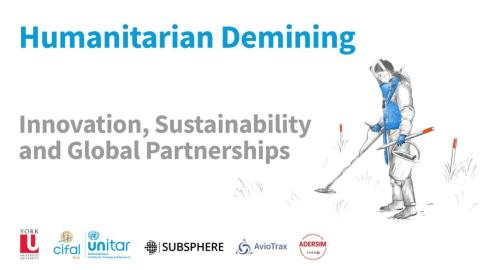
CIFAL York - Mine Action: Innovation, Sustainability, and Global Partnerships - Session 3
People
CIFAL York, ADERSIM, ADERSIM, ADERSIM
Contexte
Landmines and explosive remnants of war (ERW) continue to pose a critical humanitarian and developmental challenge worldwide. These hazards hinder infrastructure development, agricultural productivity, and socio-economic recovery directly impacting the achievement of multiple UN Sustainable Development Goals (SDGs).
Emerging technologies such as Artificial Intelligence (AI), unmanned systems, robotics, and digital twins offer transformative opportunities to accelerate clearance operations, improve safety, and enhance cost-efficiency. Simultaneously, climate change impacts exacerbate contamination dynamics, demanding integrated approaches that link technology, sustainability, and policy.
The Subsphere Co. in partnership with York University, Kyiv National Aviation University, Kyiv Polytechnic Institute, and Ukrainian deminers and technology developers proposes a global speaker series that unites, deminer, applied research centers, academia, policymakers, industry, and humanitarian actors to shape the future of mine action through innovation and sustainability.
Objectifs du cours
The speaker series is structured to address landmine and explosive remnants of war (ERW) challenges through a strictly humanitarian, civilian-protection-oriented framework, with clearly defined ethical, legal, and operational boundaries between humanitarian and military applications of technology.
Objectifs d'apprentissage
Its core learning objectives are:
- Advance applied knowledge for humanitarian landmine and ERW mitigation by presenting cutting-edge but non-weaponized technologies—including artificial intelligence, autonomous and robotic sensing platforms, geospatial analytics, and predictive contamination modeling—designed exclusively to improve detection accuracy, operational safety, and clearance efficiency in accordance with International Mine Action Standards (IMAS) and humanitarian principles.
- Define and reinforce clear boundaries between humanitarian and military technologies, ensuring that all tools, methodologies, and case studies discussed are limited to civilian protection, survey, risk reduction, and clearance support. The series explicitly excludes weaponization, targeting, strike optimization, or offensive military use, and addresses governance, dual-use risk management, and safeguards to prevent technology diversion.
- Foster a multi-stakeholder coordination platform for humanitarian mine action, bringing together academic institutions, United Nations agencies, industry partners, and NGOs to align research, validation, and deployment strategies for ethically governed, transparent, and scalable solutions toward a mine-free world.
- Reinforce education, training, and professional pathways in humanitarian demining, with a focus on developing the next generation of mine action professionals equipped with technical competence, ethical awareness, risk governance skills, and a clear understanding of the limits and responsibilities of humanitarian technology deployment.
- Promote business ethics, moral accountability, and responsible innovation among technology developers and industry stakeholders, emphasizing their obligation to ensure that technologies used in humanitarian mine action are designed, governed, and commercialized in ways that prioritize civilian safety, human dignity, transparency, and long-term social impact. This includes addressing ethical design choices, dual-use risk mitigation, compliance with international humanitarian norms, responsible AI governance, and the duty of care owed by developers to affected communities and humanitarian operators.
Audience cible
- Public Health Departments
- Emergency Management Agencies
- Law Enforcement and Public Safety Professionals
- National Safety Authorities
- Mine Action Professionals
- Demining Technology Companies
- Health & Safety Professionals
- International Organizations (UNMAS, etc.)
- Humanitarian NGOs and NGOs in related sectors
- Public Policy Researchers and Professionals
- Disaster and Emergency Management Professionals
- Professors and Students in related fields
- First Response Organizations