UNITAR Online Catalogue
The United Nations Chemicals and Waste Management Study Programme
Planet
Contexte
UNITAR has been a global leader in capacity building since 1963, providing over 500,000 learning initiatives annually. Through its Division for Planet, UNITAR’s Chemicals and Waste Management Programme supports countries in the implementation of international agreements related to chemicals and waste, including:
- Basel Convention (transboundary movement of hazardous waste)
- Rotterdam Convention (prior informed consent for trade in hazardous chemicals)
- Stockholm Convention (eliminating persistent organic pollutants, POPs)
- Minamata Convention (mercury)
- Global Framework on Chemicals
UNITAR’s Chemicals and Waste Management Programme provides support to governments and stakeholders to strengthen their institutional, technical, and legal infrastructure and capacities for the sound management of chemicals. The Programme has a rich experience in developing guidance and training material, to support countries’ needs, on topics like national waste management strategies and governance, national assessments and plans, persistent organic pollutants (POPs), Globally Harmonized System of Classification and Labelling of Chemicals (GHS), plastics management, mercury, and pollutant release and transfer registers (PRTRs). As of 2026, UNITAR is the host of the Inter-Organization Programme for the Sound Management of Chemicals (IOMC) Secretariat.
The IOMC, established in 1995, is a long-standing inter-agency coordination mechanism that strengthens international cooperation on chemicals and waste management by aligning the work of key global institutions, including FAO, ILO, UNDP, UNEP, UNIDO, WHO, OECD, UNITAR, the World Bank Group, and the Basel, Rotterdam, and Stockholm Conventions. Through coordinated action, the IOMC supports countries with scientific, technical, legislative, and financial tools to advance the sound lifecycle management of chemicals and waste, contributing to human health, environmental protection, and sustainable development.
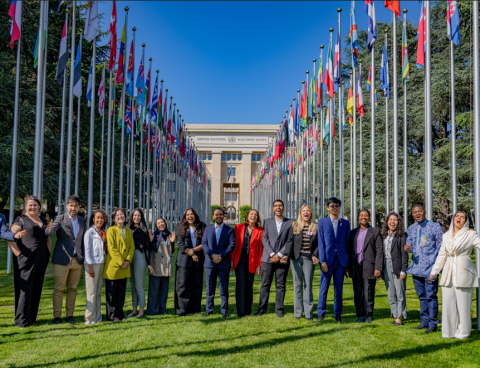
Geneva is home to several conventions and UN bodies mandated to advance safe chemicals and waste management, including the Basel, Rotterdam, and Stockholm (BRS) Conventions, the Minamata Convention, the WHO, ILO, UNECE, UNEP, a World Bank Regional Office and the IOMC Secretariat, as well as local chemicals-focused entities, such as Geneva authorities and private sector recycling facilities, making it an ideal hub for this immersive learning experience.
Objectifs du cours
- Strengthen participants’ technical knowledge of chemicals management, hazardous waste, circular economy approaches, and chemicals-related agreements.
- Build skills necessary for engaging effectively with Multilateral Environmental Agreements (MEAs).
- Promote the principles of multilateralism and environmentally sound management of waste and chemicals.
- Offer insights into career and networking pathways in international environmental governance.
Objectifs d'apprentissage
- Explain the global architecture of chemicals and waste governance, including international agreements, UN agencies, and scientific bodies.
- Describe the global system for chemicals and waste management.
- Identify tools, methodologies, and financing mechanisms relevant to chemicals and waste management.
- Build networks with Geneva-based secretariats, UN agencies, and technical institutions.
- Understand career pathways in international environmental governance.
Contenu et structure
The programme integrates expert lectures, technical workshops, site visits, and career sessions.
Méthodologie
Sessions are highly interactive and use multiple methods:
- Lectures and keynote discussions
- Hands-on exercises and simulations
- Case-study discussions
- Demonstrations of chemical management tools (toolkits, inventories, reporting platforms)
- Group discussions with UN personnel
All sessions will be conducted in English.
Audience cible
This programme is ideal for researchers, graduate students, and early-career professionals.
A maximum of 30 participants will be accepted on a first-come, first-served basis.
Participants completing the programme will receive a UNITAR Certificate of Completion.
Informations supplémentaires
UNITAR will be responsible for the overall design, coordination, and implementation of the Study Programme. It will liaise with participants on a regular basis prior to the activity's implementation in order to ensure a smooth and organization for everyone involved.
The participants are responsible for purchasing their own travel tickets to and from Geneva, as well as applying for a visa to Switzerland. UNITAR can support this process with the help of an official visa invitation letter. Participants further need to take care of their own accommodation and daily meals.
UNITAR will sponsor a welcome dinner for the participants, a welcome package including relevant training materials, and entry tickets to sights and museums. For further inquiries, kindly email multilateralism [at] unitar.org (cwm[at]unitar[dot]org).
Please read this before registration: "I understand that the United Nations Institute for Training and Research (UNITAR) does not insure participants in the above-described activity, and I am advised to arrange at my own expense insurance against sickness, accident, permanent or temporary disability, death, and third-party risk for the period of the meeting, including travel time".
In the event that an insufficient number of participants have registerted, UNITAR reserves the right to amend the dates of the scheduled programme. The delivery of the workshop is subject to a minimum of 20 participants, with a maximum of 30 participants to be accepted on a first-come, first-served basis.