UNITAR Online Catalogue
CIFAL Victoria - Indigenous-led Impact Assessment
People
University of Victoria, CIFAL Victoria
Antecedentes
Current Impact Assessments (IA) have major flaws, as they:
-Lack understanding of values, valued components (VCs), and indicators
-Offer inadequate guidance as to how VCs should be identified and prioritized
-Fail to account properly for the values and knowledge of local communities, and
-Fall short of national and international commitments to respect Indigenous Rights (K. Kwon et. Al, 2024).
To address these shortcomings, a new approach is emerging: Indigenous-led Cumulative Impact Assessments. An Indigenous-led Impact Assessment is a community-led process that Indigenous communities and organizations can use to identify what matters to them. The process is based on the values, knowledge, and governance system of the local Indigenous community.
This is a deliberate, community-driven approach that centres Indigenous knowledge, perspectives, culture, and values along with western science to better address community goals and well-being regarding IAs and cumulative effects assessments (CEAs). This is a fundamental shift from reactive project-based IA to proactive community-based Indigenous-led IAs to support Indigenous control and self-determination at the project, territory, and regional scale.
Objetivos del evento
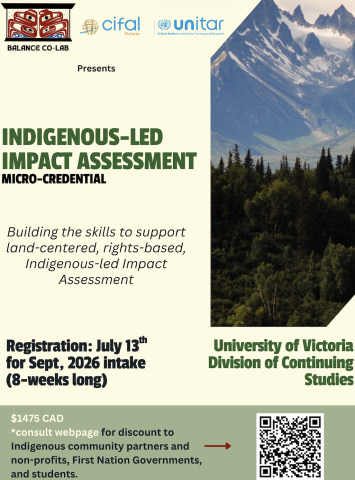
In the field of Indigenous-led Impact Assessment there are very few resources or courses available to those who wish to learn the skills necessary to support or develop an assessment process. This course is meant to fill this need for Indigenous Nations and organisations, and contractors and advisors who support their work.
Objetivos del aprendizaje
Upon completion of this course, you will be able to...
- Understand Indigenous Rights, Self-determination, Governance, and Ways of Knowing and Being, and what is required to uphold and protect them.
- Understand how Cumulative Impact Assessment processes support the fulfillment of rights, reconciliation, and interests of Indigenous Nations.
- Apply Indigenous Knowledge with Western Science in Impact Assessments.
- Utilize methods of Indigenous community-based research to identify Indigenous laws, governance practices, values, valued components for Impact Assessments, and indicators of well-being for application in Impact Assessments systems.
Understand what an Indigenous-led Impact Assessment is and support their development and implementation.
Contenido y estructura
Pre-course learning
Set of readings for learners to review and explore before the course begins to build foundational understanding.
Readings:
- Video: "The Indian Act Explained" (APTN, 10 min) – Overview of how the Indian Act continues to impact Indigenous governance today.
- Short Article: "What is the Doctrine of Discovery?" (Yellowhead Institute, 5 min read) – Background on colonial legal frameworks.
- Podcast Episode: "Unreserved – Indigenous Governance and Sovereignty" (CBC, 20 min) – Insights on governance before and after colonization.
Topic 1 History and Effects of Colonization
Week 1: History and Effects of Colonization
Video interview: Indigenous governance and environmental stewardship before colonization; the imposition of colonial systems; global history and ongoing impacts of colonization and links to economic system. (90 minutes)
Readings:
Borrows, J. (2010). “Living Legal Traditions” in Canada’s Indigenous Constitution. University of Toronto Press. [Access on Brightspace or through UVic Library]. (p 1 - 17). Focuses on traditional Indigenous governance and laws in Canada, offering examples of how Indigenous legal traditions functioned prior to colonization. (1 hour)
Coulthard, G. S. (2014). “Colonialism and Governance” in Red Skin, White Masks: Rejecting the Colonial Politics of Recognition. University of Minnesota Press. [Access on Brightspace or through UVic Library]. (Chapter 2: p 39 - 66). Focuses on historical impacts of colonization on governance systems, with an emphasis on sovereignty and resistance. (1.5 hours)
Pasternak, S.; King, H.; et. Al. (2019). Land Back: A Yellowhead Institute Red Paper. Yellowhead Institute. (p. 12 – 21) Access at: https://redpaper.yellowheadinstitute.org/wp-content/uploads/2019/10/red… (30 minutes)
Week 2: Health Impacts of Colonization
Video interview: We focus on how colonization affects women in Aotearoa; displacement of Indigenous women from governance roles. (40 minutes)
Readings:
UN General Assembly. (2007). Read “Articles 3, 18, 19, 25–28” in United Nations Declaration on the Rights of Indigenous Peoples (UNDRIP). (7 pages.) These articles focus on Indigenous governance and inherent rights. Access at: https://www.ohchr.org/sites/default/files/Documents/Publications/Declar… (10 minutes)
Pasternak, S.; et. Al. (2021). Cash Back: A Yellowhead Institute Red Paper. Yellowhead Institute. (p. 7 – 15) Access at: https://cashback.yellowheadinstitute.org/wp-content/uploads/2021/05/Cas… (20 minutes)
Assignment #1 for Topic 1 content.
Topic 2: Environmental Impact Assessment
Week 3: Canada Impact Assessment Evolution
Video interview: Global and Canadian approaches to IA; the shift to Canada’s Impact Assessment Act (2019); limitations of current approaches. (120 minutes)
Readings:
Tsuji, S. R. J. (2022). Canada’s Impact Assessment Act, 2019: Indigenous Peoples, Cultural Sustainability, and Environmental Justice. Sustainability 14, no. 6 (2022). Access at: https://doi.org/10.3390/su14063501
(1.5 hours)
Sankey, J., Scott, D., and Tanguay, L. (2023). Operationalizing Indigenous Impact Assessment. Impact Assessment Agency of Canada. (p. 13-24) 30 min
Environmental Impact Assessment in New Zealand https://www.doc.govt.nz/get-involved/apply-for-permits/managing-your-co… (15 minutes)
Assignment #2 for Topic 2 content.
Topic 3: Cumulative Impact Assessment
Week 4: Cumulative Impact Assessment
Video interview: What cumulative impacts are and how they interact; methods of CIA including valued component, effects-based, and stressor-based approaches; management strategies and what makes a meaningful CIA. (20 minutes)
Readings:
Blakley, Jill, and Jessica Russell. “International Progress in Cumulative Effects Assessment: A Review of Academic Literature 2008-2018.” Journal of Environmental Planning and Management 65, no. 2 (2022). https://doi.org/10.1080/09640568.2021.1882408. (p. 186-202) 1 hour
Blakley, Jill. “Introduction: Foundations, Issues and Contemporary Challenges in Cumulative Impact Assessment.” In Handbook of Cumulative Impact Assessment, edited by Jill Blakley and Daniel Franks. Edward Elgar Publishing, 2021. https://doi.org/10.4337/9781783474028.00011. (p. 2-17) 45 min
Roudgarmi, Pezhman. “Cumulative Effects Assessment (CEA), A Review.” Journal of Environmental Assessment Policy and Management 20, no. 2 (2018). https://doi.org/10.1142/S1464333218500084. (13 pages) 30 min
Assignment #3 for Topic 3 content.
Topic 4: Indigenous-led Cumulative Impact Assessment
Week 5: Introduction to Indigenous-led Approaches
Video interview: What is Indigenous-led impact assessment? Discussions from Canada and Aotearoa. (120 minutes)
Readings:
Sankey, J., Scott, D., and Tanguay, L. (2023). Operationalizing Indigenous Impact Assessment. Impact Assessment Agency of Canada. (p. 1-7) 30 min
Keefer, J., Murphy, M. , Wabegijig, S., and Stark, H.(2025). “The Limitations and Transformative Potential of Indigenous-Led Environmental Impact Assessments in Canada.” Canadian Public Administration68: 503–518. https://doi.org/10.1111/capa.70029 1 hour
Week 6: Supporting Indigenous-led Approaches
Video interview: How can settlers support Indigenous-led approaches? (40 minutes)
Readings:
Adams et al., (2023). Inclusive Approaches for Cumulative Effects Assessments. People and Nature. (Kitasoo Xai’xais, Nuxalk, Wuikinuxv First Nations)
Kwon, K., Rutherford, M., & Gunton, T. (2024). A new model for selecting valued components in environmental assessment: Lessons from an Indigenous-led cumulative effects management program. Environmental Impact Assessment Review, 106, 107519-. https://doi.org/10.1016/j.eiar.2024.107519 (approx. 10 pages) 30 min
Ciaran O’Faircheallaigh (2017) Shaping projects, shaping impacts: community-controlled impact assessments and negotiated agreements, Third World Quarterly, 38:5, 1181-1197, DOI: 10.1080/01436597.2017.1279539. https://doi.org/10.1080/01436597.2017.1279539. (17 pages) 45 min
Week 7: Actioning Indigenous-led Assessment Systems
Video interview: Exploring two Nation assessment systems in Canada that have been implemented. (100 minutes)
Readings:
Arnold et al. (2024). Addressing Cumulative Effects through an Indigenous-led Assessment Process. Environmental Management. (Tsilhqot’in Process)
Sankey, J., Scott, D., and Tanguay, L. (2023). Operationalizing Indigenous Impact Assessment. Impact Assessment Agency of Canada. (p. 25-42; 43-65; 69-88; 89-113) 30 min
Week 8: Community-based Engagement and Research Methods
Video interview: How can these research methodologies serve Indigenous peoples? (100 minutes)
Readings:
Piñán, Astrid & Friedland, Hadley & Sayers, Judith & Murphy, Matt. (2021). Reclaiming Indigenous Economic Development Through Participatory Action Research. Journal of Human Development and Capabilities. 23. 1-20. 10.1080/19452829.2021.2009449. (p. 1-20) 1 hour
Assignment 4 due for Topic 4 content.
Topic 5: Tools
Resources shared with students that can be utilized to further their work (sustainability assessment system, Integral Ecology Group).
Carlson et al (2025) Bringing Together Indigenous Knowledge and Simulation Modelling to Assess Cumulative Impacts to Indigenous Land Use in Northeastern Alberta. Environmental Management
Metodología
The course has been structured with 8 weekly video/podcast, weekly readings, and 4 unit assignments. We chose to create podcast and video content that brings in experts who are doing this work, to provide the highest level of expertise possible, and provide real world examples of people conducting and supporting this type of work. We chose video and podcast formats to increase accessibility of content for different learners’ preferences, and to complement and animate course readings.
We chose to break units into weekly readings and videos to make it more accessible for students to tackle content on a weekly, instead of unit, basis. Weighting of readings and video/podcast content is intended to be relatively even across weeks. Unit 4 is the most content heavy week, as it the crux of the course: Indigenous-led impact assessment.
Students will be engaging with 4 course assignments that are intended to apply what they are learning through the course. Assignments have been designed to allow a student to look at a specific Nation, territory, province or federal IA process across the assignments. Each assignment is aligned with the learning objectives of the five units. The intention of these assignments is to engage with these processes in depth, to combine student learning with practical application. By following a single process, students will best be able to conduct their assessment of limitations, strengths, and potential for Indigenous-led assessment within their chosen region. The intention of these assignments is not a letter grade, but to ensure students are grasping the relevant concepts, to be sure that these processes are being approached in a culturally safe manner.
Público objetivo
Indigenous community staff, governance officers, and Nations’ environmental teams, Environmental consultants and advisors, Government policy staff and regulatory practitioners, Graduate students and researchers in environmental, legal, and Indigenous studies, Non-governmental organizations and advocacy groups