
UNITAR Online Catalogue
Environment, Natural Resources and UN Peacekeeping Operations: Restoring Governance of Natural Resources - PTP.2026.08
Peace
Antecedentes
With a view to avoid and minimize the environmental impacts of peacekeeping missions, DPKO and the Department of Field Support (DFS) adopted an Environmental Policy for UN Field Missions in June 2009. Furthermore, Global Field Support Strategy was approved by Member States in 2010. While the main aim of this five year strategy is to improve operational efficiency and transform service delivery, one of its secondary aims is to reduce the in-country environmental impact of peacekeeping and special political missions.
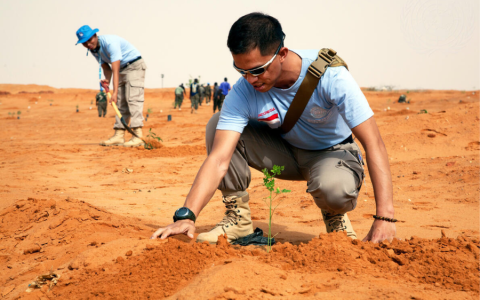
However, despite these positive developments, recent policy analysis report, titled Greening the Blue Helmets: Environment, Natural Resources and UN Peacekeeping Operations, prepared by the UN Environment Programme (UNEP) in close collaboration with DPKO and DFS, has shown that while the new policy had catalysed positive change in some peacekeeping missions – including testing and field application of resource-efficient practices, technologies and behaviours – the adoption of the policy in the field has to date been limited and ad hoc. This report further identifies opportunities for peacekeeping operations to capitalize on natural resources to contribute to stability and early peacebuilding outcomes, including employment, livelihoods, economic recovery and reconciliation.
This training course focuses on the environment and natural resource management in a post-conflict context. It is a general awareness training that targets all military, civilian and police personnel and should be completed either pre-deployment or once in-mission. Key areas of learning include minimizing the environmental impact of peacekeeping missions, improving operational efficiency from an environmental perspective and addressing environmental and natural resource challenges at field level.
Objetivos del evento
As a direct answer to the Greening the Blue report recommendation, the aim of this training module is to increase general awareness of key environmental and natural resource concepts to all peacekeeping staff.
Objetivos del aprendizaje
At the end of the course, participants will be able to:
- Explain the links among natural resources, environmental change, conflict and peacebuilding.
- Describe how natural resources have been integrated into the UM's peace and security work.
- Describe the components of and tools for natural resource governance.
- Identify how peacekeepers can help to restore the governance of natural resources in post-conflict societies.
Contenido y estructura
The course is composed of 5 sections:
- Section 1: Introduction to key concepts and definitions.
- Section 2: Review of the linkages among natural resources and conflict and peacebuilding, respectively.
- Section 3: Outline of how natural resources considerations have been integrated into UN peace and security operations.
- Section 4: Introduction to the good governance of natural resources.
- Section 5: Review of what peacekeeping operations can do to address the governance of natural resources in conflict-affected and post-conflict societies.
Metodología
The course is a self-guided, self-paced, web-based course that is on-going and can be accessed at any time. The material is presented in an interactive visual and text format with web-based reference resources. Multiple choice quizzes at the end of each lesson serve a dual function of assessing and evaluating the students’ understanding and retention and provide a further didactic function by reviewing the content.
At the successful completion of the course participants will be awarded with a badge.
Público objetivo
This general awareness raising training targets all military, police and civilian personnel working in or interested in working in peacekeeping operations.
Información adicional
Copyright
This training module was developed by UNEP’s Post-Conflict and Disaster Management Branch in collaboration with UNITAR and the International Institute for Sustainable Development (IISD).
For administrative queries, contact ptp [at] unitar.org (ptp[at]unitar[dot]org)
Certificates of completion will be sent to participants, upon the successful completion of the end-of-course quiz and after participants have filled out the course evaluation form.
Technical Requirements
UNITAR recommends the following as a minimum in hardware and software to take our e-Learning courses. Please consult your Network Administrator or Systems person to ensure that you have the following:
Hardware requirements
- Desktop or laptop computer with Windows 10 or MacOS version 11 and later
- Tablet or mobile devices are not fully supported on some course tools
- Stable LAN or Wifi Internet connection
Browser
- Latest version of Mozilla Firefox (download for free at https://www.mozilla.org)
- Latest version of Google Chrome (download for free at https://www.google.com/chrome)
- Microsoft Edge or Safari (included in your computer)
Other software
- PDF reader (download for free at https://get.adobe.com/uk/reader)
- Microsoft Office for Windows or MacOS (compatible software can be downloaded at http://www.openoffice.org/)
- Video player (Quicktime for MacOS, Windows Media Player or compatible video player)
- Anti-virus
Other requirements
- Disable Pop-up blockers
- Enable cookies and java
- webcam and audio headset for courses that will require online meetings
- additional storage in case you need to download course materials
You will receive an email with the detailed information on how to access the course within 48 hours from the registration. Please kindly check your spam or junk inbox.